Uttarakhand Itinerary 7 Days: Best Routes & Tips
Uttarakhand Itinerary 7 Days: Best Routes & Tips
What is the best 7-day itinerary for Uttarakhand?
The best 7-day Uttarakhand itinerary combines 2 nights in a Garhwal hill station (Mussoorie or Rishikesh), 2 nights in a wildlife or adventure zone (Jim Corbett or Auli), and 2–3 nights in Kumaon (Nainital, Kausani, or Binsar). This structure covers three distinct landscapes — Himalayan foothills, river valleys, and Kumaon hills — in one week without excessive travel days.
Quick Summary
| Detail | Info |
|---|---|
| Best time to visit | March–June, September–November |
| Duration | 7 days / 6 nights |
| Difficulty | Easy to Moderate |
| Who it's for | Families, couples, solo travelers, first-timers |
| Ideal base cities | Delhi, Dehradun, Kathgodam |
| Why SnazzyTrips | 21+ years on-ground in Uttarakhand, 150+ partner network, 4.7/5 rating |
Introduction
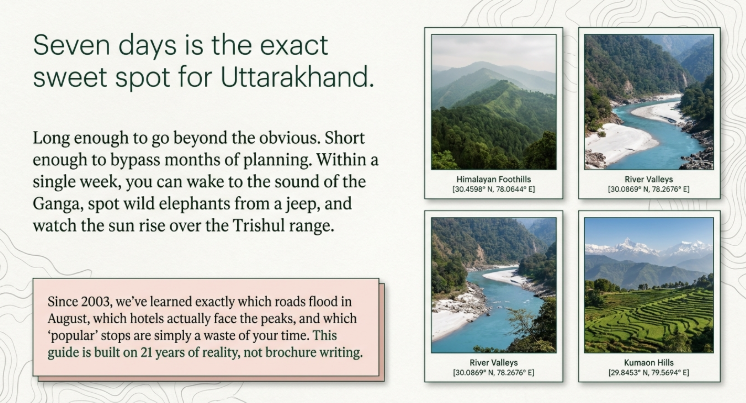
Seven days is the sweet spot for Uttarakhand. Long enough to go beyond the obvious. Short enough that you don't need months of planning.
You can wake up to the sound of the Ganga in Rishikesh on Day 2, spot a wild elephant from a jeep in Jim Corbett on Day 4, and sip kahwa tea while watching the sun rise over the Trishul range from Kausani on Day 6. That kind of variety — packed into one week — is what makes this state unlike anywhere else in India.
At SnazzyTrips, we've been curating 7-day Uttarakhand circuits since 2003. We know which roads flood in August, which hotels actually face the peaks, and which "popular" stops are simply not worth the time. This guide reflects 21 years of that on-ground knowledge — not brochure writing.
Whether you're planning independently or looking for a Uttarakhand tour package, this itinerary guide gives you the honest picture.
The Two Best 7-Day Uttarakhand Routes
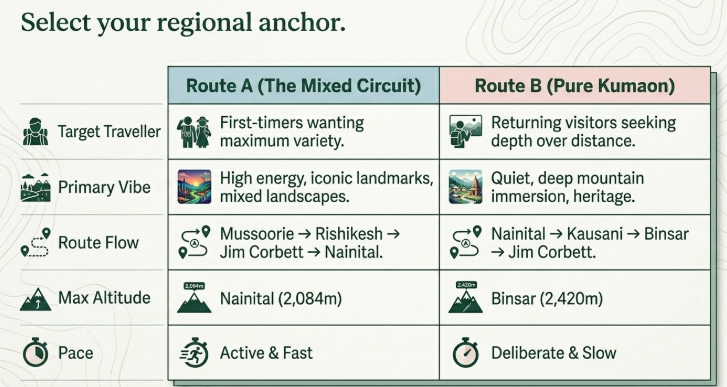
Not all travelers want the same thing. So we've built two distinct circuits — one for Garhwal-first travelers, one for Kumaon-first travelers. Both work beautifully in 7 days.
Route A: Mussoorie → Rishikesh → Jim Corbett → Nainital
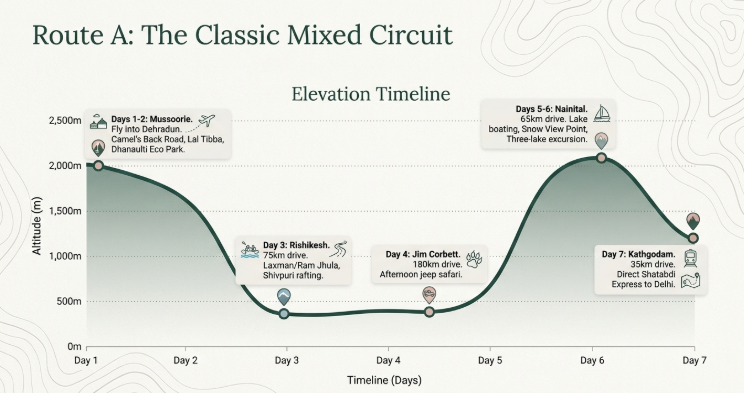
This is the classic mixed circuit. It covers both Garhwal and Kumaon and suits first-time visitors who want maximum variety.
Day 1–2: Mussoorie Arrive in Dehradun, drive up to Mussoorie (30 km, about 1 hour). On Day 1, cover Camel's Back Road, Lal Tibba viewpoint, and the Mall Road at dusk — the best time, when the crowds thin and the lights start coming on across the valley.
Day 2, head to Dhanaulti (30 km from Mussoorie). The Eco Park here is genuinely peaceful and far less crowded than anything on Mall Road. The drive itself — through dense oak and rhododendron — is the experience. Skip Kempty Falls if time is short; it's overcrowded and commercialized.
Day 3: Rishikesh Drive down from Mussoorie to Rishikesh (75 km, about 2.5 hours). Afternoon at Laxman Jhula and Ram Jhula. Evening Ganga Aarti at Parmarth Niketan — be there by 5:30 PM to get a good spot. The aarti begins at sunset and takes about 45 minutes.
If you want rafting, book it for early morning before you check out. The 16 km stretch from Shivpuri to Rishikesh is the best for mixed groups — not too extreme, genuinely exciting.
Day 4: Jim Corbett National Park Drive from Rishikesh to Ramnagar (180 km, about 4 hours). Afternoon jeep safari in the Bijrani or Jhirna zone — both are accessible without advance forest department permits on the same day, unlike Dhikala.
📍 Quick Fact: Jim Corbett has over 225 bird species and is home to one of India's highest tiger densities at approximately 231 tigers as per the last count.
Day 5–6: Nainital From Ramnagar, it's 65 km to Nainital (about 2 hours). Day 5: Naini Lake boating in the morning (before 9 AM, before the crowds arrive), Snow View Point by ropeway, and the Tibetan Market on the Mall Road. Day 6: Excursion to Bhimtal, Sattal, and Naukuchiatal — three lakes in one day. This is Kumaon at its quietest and most beautiful.
Day 7: Return via Kathgodam Kathgodam is 35 km from Nainital and has direct train connections to Delhi (Shatabdi Express, about 6 hours).
Route B: Nainital → Kausani → Binsar → Jim Corbett (Pure Kumaon)
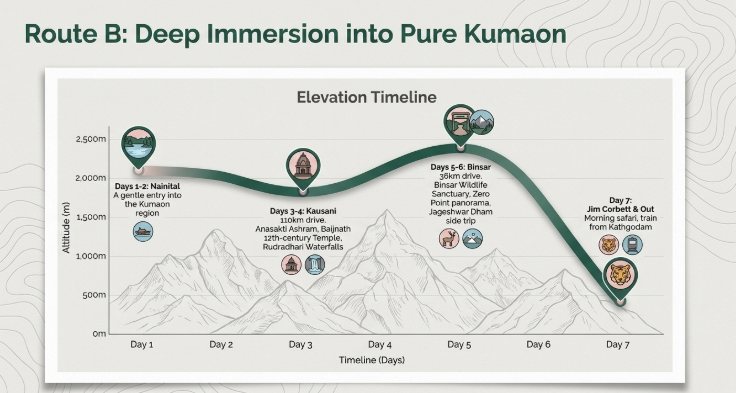
This route is for travelers who want depth over distance. It stays entirely in the Kumaon region — SnazzyTrips' home ground — and goes deeper into the hills than most operators take you.
Day 1–2: Nainital Same as Route A Day 5–6 above. Nainital first gives you a gentle entry into Kumaon.
Day 3–4: Kausani From Nainital, drive to Kausani (110 km, about 3.5 hours via Almora). Kausani sits at 1,890 metres. On a clear morning, the panorama stretches across Trishul, Nanda Devi (7,816 m — India's second-highest peak), and Panchachuli. Mahatma Gandhi called it the "Switzerland of India" after staying here in 1929.
Day 3 afternoon: Anasakti Ashram and the Tea Gardens. Day 4: Drive 19 km to Baijnath Temple — a 12th-century Shiva temple complex with remarkable stone carvings — then the Rudradhari Waterfalls. Pick up local woollens and Kumaoni green tea before leaving.
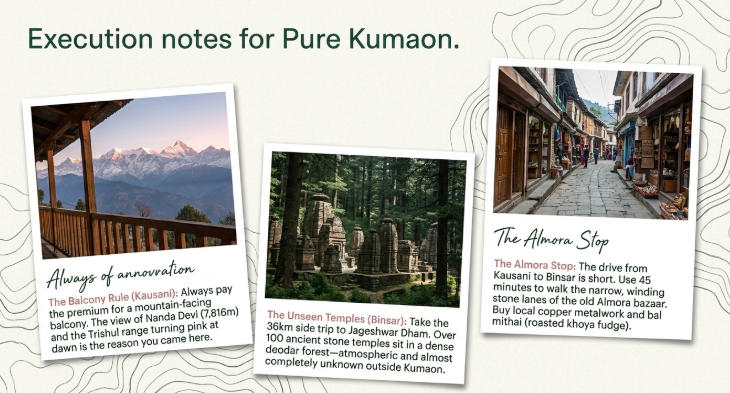
🧭 Traveler Tip: In Kausani, book a room with a mountain-facing balcony. The peak view at dawn, when the sky turns pink behind Nanda Devi, is worth every rupee extra.
Day 5–6: Binsar Binsar (2,420 m) is 36 km from Kausani. The Binsar Wildlife Sanctuary has leopards, Himalayan black bears, and over 200 bird species. The Zero Point viewpoint offers a 300 km Himalayan panorama on clear days — one of the widest unobstructed views in Uttarakhand.
Side trip on Day 5: Jageshwar Dham, 36 km from Binsar. Over 100 ancient stone temples set in a dense deodar forest. Atmospheric, quiet, and almost entirely unknown outside Kumaon.
Day 7: Jim Corbett — Drive Out From Binsar, drive to Ramnagar for a morning safari before heading to Kathgodam for your train home.
SnazzyTrips Insights
A note from our team at SnazzyTrips:
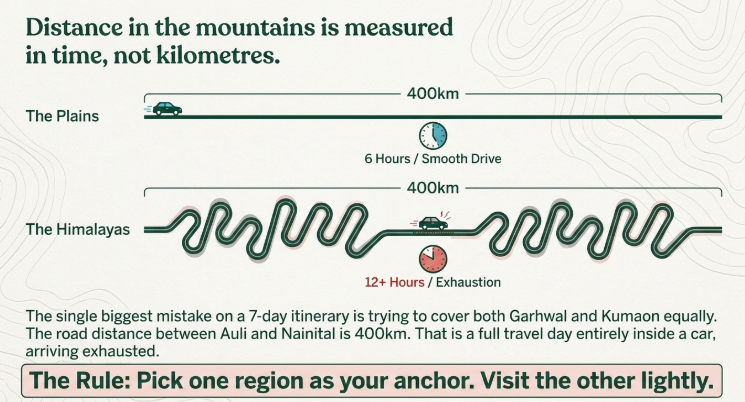
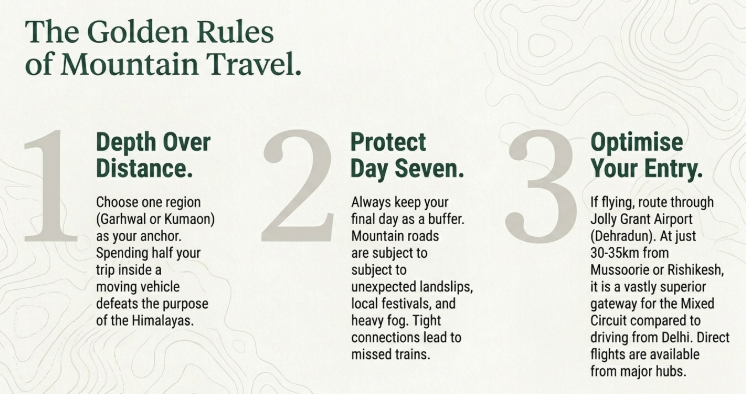
Over 21 years of operating in Uttarakhand, the single biggest mistake we see travelers make on a 7-day itinerary is trying to cover both Garhwal and Kumaon equally. The road distance between, say, Auli and Nainital is nearly 400 km through mountain roads. That's a full travel day — sometimes more. The traveler ends up spending Day 4 entirely in a car, arriving exhausted.
Our advice: Pick one region as your anchor and visit the other lightly. If you've never been to Uttarakhand, Route A (mixed circuit) works well. If you've seen Rishikesh and Nainital before, Route B (pure Kumaon) will show you a side of this state that most visitors — and most operators — simply don't know.
We also recommend always keeping Day 7 as a buffer. Mountain roads face unexpected delays — landslips, festivals, fog. Travelers who plan tight connections on Day 7 often miss trains. Build in flexibility.
Best Time to Visit Uttarakhand: Month by Month
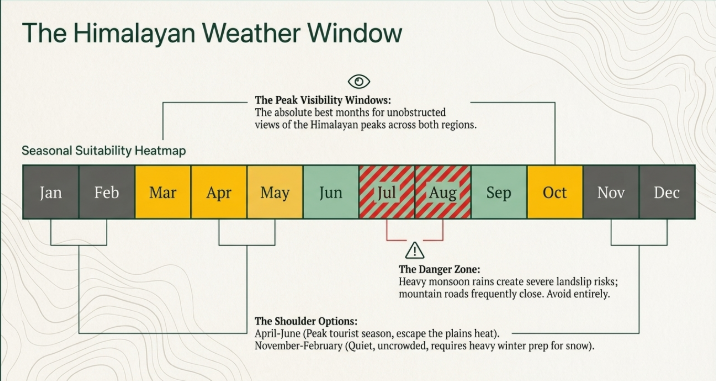
| Month | Weather | Suitability | Notes |
|---|---|---|---|
| January | Cold (0–10°C in hills) | Good for Auli snow | Auli skiing season; Nainital foggy |
| February | Cold, dry | Good | Rhododendrons start blooming |
| March | Pleasant (10–20°C) | Excellent | Best month — clear skies, full Himalayan views |
| April | Warm in plains, cool in hills | Excellent | Peak season begins; book in advance |
| May | Hot in plains (30°C+), cool hills | Very Good | Busy but good weather in hills |
| June | Pre-monsoon heat | Moderate | Go early in month; avoid after June 15 |
| July | Monsoon | Avoid road trips | Landslip risk on mountain roads; Corbett stays open |
| August | Heavy rain | Avoid | Highest landslip risk; roads can close |
| September | Rain tapering | Good from mid-Sep | Valley of Flowers last chance; waterfalls at peak |
| October | Clear, cool | Excellent | Best for Kumaon; festivals (Navratri, Diwali) |
| November | Cold starts (5–15°C) | Very Good | Quiet, uncrowded, clear views |
| December | Cold (0–5°C in hills) | Good for snow lovers | Munsiyari and Chopta get snowfall |
📍 Quick Fact: October and March are Uttarakhand's two peak visibility months — Himalayan peaks are clearly visible from destinations across both Garhwal and Kumaon.
What to Pack for a 7-Day Uttarakhand Trip

Keep it light. Mountain roads mean you carry your bags up stairs more often than you'd expect.
Clothing:
- 2–3 layers for evenings (even in summer, hills drop to 12–15°C after dark)
- One rain jacket (useful even outside monsoon — sudden showers are common)
- Comfortable walking shoes — you'll use them every day
Documents and Essentials:
- Valid ID (required for Jim Corbett safari booking and some hotel check-ins)
- Corbett safari permit booking confirmation (if pre-booked online)
- Offline maps downloaded (Uttarakhand mobile signal can be patchy above 2,000 m)
Health:
- Motion sickness tablets if prone — mountain switchbacks are unavoidable
- Basic first aid: antihistamines, antacids, paracetamol
- Sunscreen SPF 50+ — UV intensity at altitude is significantly higher than in the plains
Cost Breakdown for 7 Days in Uttarakhand
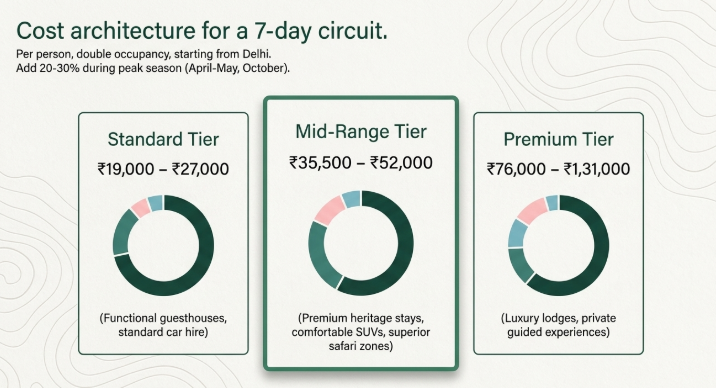
All figures are per person, based on double occupancy, road travel from Delhi.
| Item | Budget | Mid-range | Premium |
|---|---|---|---|
| Accommodation (6 nights) | Rs. 4,800–7,200 | Rs. 12,000–18,000 | Rs. 30,000–60,000 |
| Meals (all days) | Rs. 2,500–3,500 | Rs. 5,000–8,000 | Rs. 12,000–18,000 |
| Transport (car hire, 7 days) | Rs. 8,000–10,000 | Rs. 12,000–16,000 | Rs. 20,000–28,000 |
| Corbett Safari (per person) | Rs. 2,500–3,500 | Rs. 3,500–5,000 | Rs. 8,000–15,000 |
| Activities & entry fees | Rs. 1,500–2,500 | Rs. 3,000–5,000 | Rs. 6,000–10,000 |
| Total (approx.) | Rs. 19,000–27,000 | Rs. 35,500–52,000 | Rs. 76,000–1,31,000 |
Note: Prices are approximate and vary by season. Peak season (April–May, October) rates run 20–30% higher than shoulder months.
Insider Tips From 21 Years on the Ground
1. Don't book Dhikala zone at Jim Corbett last minute. Dhikala is the deepest and most rewarding zone. It requires an overnight stay inside the park and advance booking through the forest department portal. Spots fill weeks ahead in peak season. If you haven't booked, Bijrani and Jhirna zones offer excellent wildlife sightings without the advance hassle.
2. Mussoorie on weekends is a different experience — and not a better one. Friday evening to Sunday, the Mall Road is genuinely difficult to walk on. If your itinerary allows flexibility, start in Mussoorie on a Tuesday or Wednesday. You'll have the same views and a fraction of the traffic.
3. Kausani to Binsar is a short drive but don't rush it. The road passes through Almora, and the old Almora bazaar — a narrow, winding stone lane — is worth 45 minutes of your time. Local copper metalwork, Kumaoni pickles, and bal mithai (a local fudge made from roasted khoya) are all worth taking home.
4. For travelers flying into Dehradun: Jolly Grant Airport is 35 km from Rishikesh and 30 km from Mussoorie. It's a far more convenient gateway for Route A than driving from Delhi. Direct flights operate from Mumbai, Kolkata, Bangalore, Chennai, and Ahmedabad.
Travelers flying from South India or the west coast might also explore Uttarakhand packages from Bangalore, packages from Mumbai, or packages from Chennai — all of which include flight routing via Dehradun or Kathgodam.
FAQ
Q: What is the best 7-day Uttarakhand itinerary for first-timers? A: The Mussoorie–Rishikesh–Jim Corbett–Nainital circuit covers the state's most iconic experiences — colonial hill station, spiritual river town, wildlife safari, and lake district — in a logical route without backtracking. This is the route the SnazzyTrips team recommends to most first-time visitors.
Q: Is 7 days enough for Uttarakhand? A: Seven days is enough to see one region in depth — either Garhwal or Kumaon — or to get a good sampler of both. It is not enough to cover the entire state. Char Dham Yatra alone takes 10–12 days. For a complete Uttarakhand experience, 10–14 days is ideal.
Q: How much does a 7-day Uttarakhand trip cost from Delhi? A: Budget travelers can manage Rs. 19,000–27,000 per person (double occupancy, road travel). Mid-range trips cost Rs. 35,000–50,000. Premium experiences including luxury resorts and private safaris range from Rs. 75,000–1,30,000. Prices rise 20–30% in peak season (April–May, October).
Q: Is Uttarakhand safe to visit in the monsoon (July–August)? A: Uttarakhand receives heavy rainfall between mid-June and September. Landslips on mountain roads are common, especially on the Rishikesh–Badrinath and Nainital–Bhowali routes. Wildlife tourism at Jim Corbett continues through monsoon, but most other road trips are best avoided in July and August. September onwards is safe and beautiful.
Q: Can I do Char Dham Yatra in 7 days? A: A complete Char Dham Yatra (Yamunotri, Gangotri, Kedarnath, Badrinath) typically requires 10–12 days by road. A 7-day version is possible by helicopter — Kedarnath and Badrinath by helicopter can be covered in 5–6 days with Delhi travel days included. The SnazzyTrips team handles helicopter Char Dham bookings; visit snazzytrips.in for current availability.
Q: Which is better for 7 days — Garhwal or Kumaon? A: Both regions are distinct. Garhwal (Mussoorie, Rishikesh, Auli, Chopta) suits travelers who want adventure, spirituality, and dramatic mountain terrain. Kumaon (Nainital, Kausani, Binsar, Munsiyari) suits travelers who want quiet, offbeat hill culture, wildlife, and deep Himalayan views. First-timers often prefer Garhwal. Repeat visitors almost always fall for Kumaon.
Q: Do I need to book Jim Corbett safari permits in advance? A: Yes, for the Dhikala zone — book at least 45–60 days ahead on the official forest department portal during peak season. For Bijrani, Jhirna, Durga Devi, and Sitabani zones, advance booking of 7–15 days is usually sufficient. Same-day booking is sometimes possible for Jhirna and Sitabani. Travel agents registered with the SnazzyTrips network can assist with permit bookings and zone selection.
Travel Packages