
Panchachuli Peaks Munsiyari: Best Viewpoints & Guide
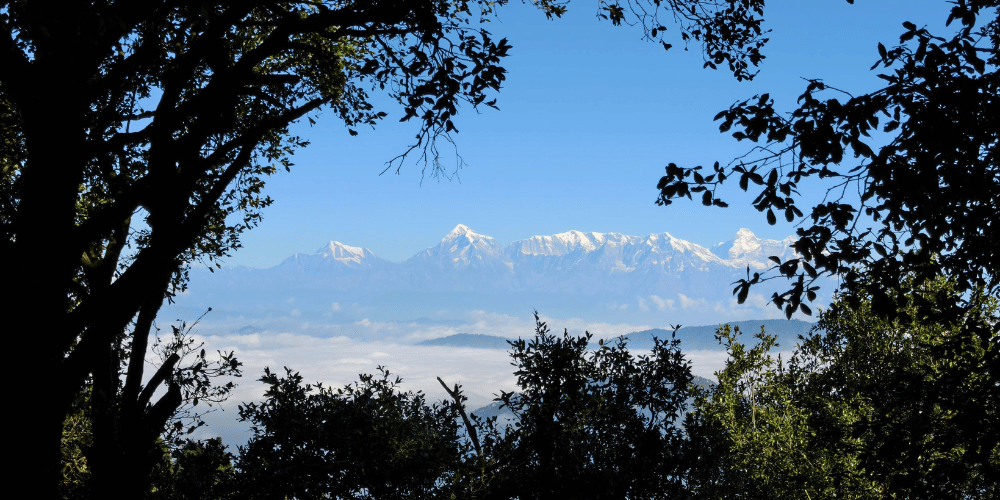
People drive two days to Munsiyari for one reason: Panchachuli.
Five snow summits rise across the Gori Ganga valley, close enough to fill a hotel window. On a clear October morning they look near enough to touch. On a cloudy afternoon, you may not see them at all. Which one you get depends on where you stand, what time you look, and which month you travel.
This guide is about getting that view right. It covers:
- what Panchachuli actually is
- the best viewpoints in and around Munsiyari, and the light at each
- the season-by-season picture
- room and photography tips
- how we plan view-focused trips from Haldwani and Kathgodam
One honest correction runs through it all: most guides say Panchachuli “glows pink at sunrise” from Munsiyari. Read the timing section before you set your alarm.
Quick Answer
Where is the best place to see Panchachuli from Munsiyari?
Easiest: a Panchachuli-facing hotel room or terrace on the Munsiyari town ridge.
Best local viewpoints:
- the Nanda Devi Temple ridge
- Betuli Dhar
- the Sarmoli and Darkot village trails
- Kalamuni Top on the drive in
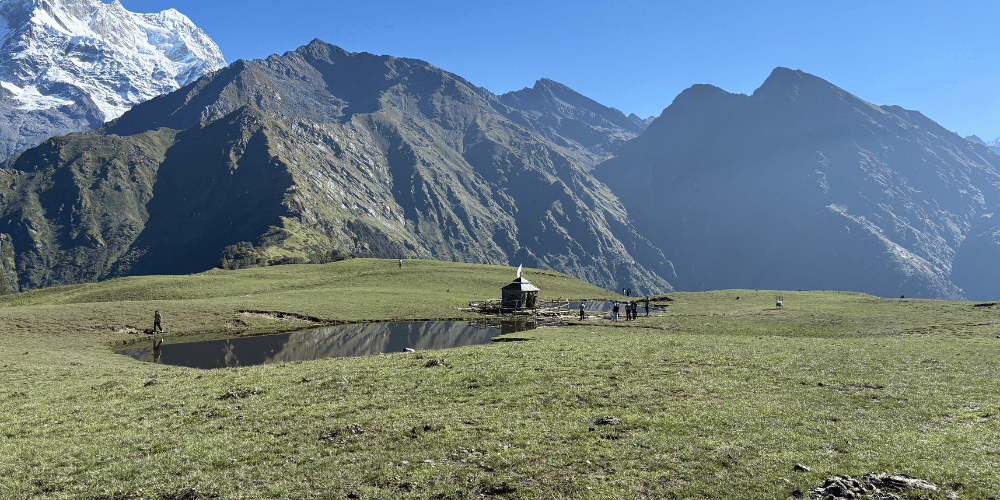
Widest view: Khaliya Top (about 3,500 m), a day trek from Balati.
Best time of day: early morning for the clearest air, and late afternoon to sunset for the warmest colour on the peaks.
Best months: October and November. March to May is a good second choice.
Minimum stay: two nights in Munsiyari, so you get two chances at a clear morning.
What Are the Panchachuli Peaks?
| Detail | Information |
|---|---|
| Name meaning | “Five chulhas” (hearths) |
| Number of peaks | Five, named Panchachuli I to V |
| Height range | Roughly 6,300 m to just over 6,900 m |
| Highest | Panchachuli II, about 6,904 m |
| Location | Pithoragarh district, Kumaon, on the divide between the Gori Ganga and Darma valleys |
| Seen from | Munsiyari (western side), Chaukori and Kalamuni from afar, Darma valley (eastern side) |
| Legend | The five Pandavas cooked their last meal here on five hearths before heading to heaven |
From Munsiyari, you see the western faces of the range directly across the Gori Ganga valley. That’s why Munsiyari is called the best road-accessible Panchachuli viewpoint: there’s no ridge in between, just air.
The Best Panchachuli Viewpoints Around Munsiyari
1. Your hotel room or terrace (Munsiyari town ridge)
The most underrated viewpoint is the one you sleep in. Hotels along the upper ridge of Munsiyari face the range directly. A good room gives you the view from bed at 6 AM with tea, without walking anywhere.
The catch: not every room in a “Panchachuli view hotel” faces Panchachuli. Some face the road or the hillside behind. Ask specifically for a Panchachuli-facing room and confirm it in writing. View rooms are the core of our Munsiyari honeymoon package, where couples tend to care most about this.
Best for: everyone, especially seniors, families with young kids, and anyone not keen on early walks.
2. Nanda Devi Temple ridge
A short drive and walk above town, the Nanda Devi Temple sits on an open ridge with a clean, unobstructed angle to the whole range. It’s quieter than the town and has no wires or rooftops in the frame.
Best time: late afternoon to sunset, when the peaks pick up warm light.
Time needed: 45–60 minutes including the walk.
3. Betuli Dhar
A grassy ridge a short drive from town, popular with locals for evening walks. It gives a slightly wider angle than the temple ridge and takes in more of the Gori Ganga valley below the peaks. In winter, it’s also one of the easiest snow spots near Munsiyari.
Best time: sunset.
Good for: wide landscape photos and an evening walk.
4. Sarmoli and Darkot village trails
Walk the lanes below town through Sarmoli and down towards Darkot, and the peaks appear behind slate-roofed houses, terraced fields and drying wool. It’s the view with the most character, even if the peaks are slightly lower in the frame.
Best time: early morning, when village life is starting up.
Good for: photographers wanting a foreground, and slow travellers.
5. Kalamuni Top (on the drive in)
At around 2,700 m on the Thal–Munsiyari road, Kalamuni is where most travellers see Panchachuli for the first time. There’s a small temple at the pass and space to pull over. On a clear afternoon, the whole range lines up in front of you.
Best time: whenever you pass in clear weather, so ask your driver to stop.
Winter note: Kalamuni is also where snow closes the road first.
6. Balati Bend
The roadside bend on the Kalamuni road where the Khaliya Top trek starts. Even if you don’t trek, the open stretch around Balati gives a good elevated view back across the valley to the range.
Best time: early morning, before the trek crowds.
7. Khaliya Top (the widest view)
A day trek of about 6–7 km from Balati takes you to an alpine meadow at roughly 3,500 m. From here Panchachuli is joined by Nanda Devi, Nanda Kot, Rajrambha and Hardeol in one sweep. It’s the finest view in the area, but you have to earn it, and you need to be on top by late morning before clouds build.
8. Chaukori (on the way, from a distance)
Chaukori’s tea-garden ridge, about three hours before Munsiyari, has a long view of the Himalaya that includes Panchachuli on clear days. It’s further away and smaller in the frame, but it makes a lovely first-night preview. We use Chaukori as a halt for exactly this reason.
Viewpoint comparison
| Viewpoint | Effort | Best light | View type |
|---|---|---|---|
| Hotel room or terrace | None | Morning and sunset | Direct, close |
| Nanda Devi Temple ridge | Easy | Sunset | Clean, unobstructed |
| Betuli Dhar | Easy | Sunset | Wide, with valley |
| Sarmoli and Darkot trails | Easy walk | Early morning | Village foreground |
| Kalamuni Top | Roadside | Clear afternoon | First view, elevated |
| Balati Bend | Roadside | Early morning | Elevated, across valley |
| Khaliya Top | Day trek | Mid-morning | Widest panorama |
| Chaukori | On the route | Morning and sunset | Distant, wide range |
When to Look: Getting the Timing Right
Here’s where most guides get it backwards.
Panchachuli lies east of Munsiyari. At sunrise, the sun comes up behind or beside the range. You see the peaks as dark outlines against a bright sky, with gold along the edges. It’s beautiful, but it isn’t the pink-faced glow most people expect.
The colour comes in the evening. As the sun drops behind you in the west, it lights the western faces of the peaks directly. In the last 30–40 minutes before sunset, they turn gold, then orange, then pink, and then fade to blue.
So plan both:
| Time | What you see | Why go |
|---|---|---|
| 5:45–7:30 AM | Peaks outlined against a bright sky, gold rim light, often the clearest air | Clearest visibility; clouds usually haven’t formed yet |
| 7:30–10:00 AM | Peaks in full daylight, crisp and white | Best for clean, detailed photos |
| 10 AM–3 PM | Clouds often build around the summits | Lowest chance of a clear view |
| Last hour before sunset | Gold, orange and pink on the peaks | The famous colour |
| After dark (clear nights) | Snow faintly visible under stars or moonlight | Night and star photography |
Our rule of thumb: morning for clarity, evening for colour, and two nights for insurance.
Best Season for Panchachuli Views
| Months | Visibility | What to expect |
|---|---|---|
| October–November | Excellent | Sharpest, clearest views of the year; dry air; cold mornings |
| December–February | Very good on clear days | Peaks and town in snow; cold; road closures possible at Kalamuni |
| March–April | Good | Rhododendrons in bloom; some spring haze by afternoon |
| May–June | Fair to good | Warmer; haze and afternoon clouds more common |
| July–September | Poor | Monsoon cloud often hides the range for days |
If seeing Panchachuli clearly is the whole point of the trip, travel in October or November.
Panchachuli from the Other Side: Darma Valley and Base Camp
You may see “Panchachuli Base Camp trek from Munsiyari” online. That’s wrong.
The base camp approach is on the eastern side of the range, in the Darma valley, reached via Dharchula and the village of Duktu. It’s a separate trip of several days. Inner line permits may be needed for the Darma valley, so plan it in advance with your operator.
The Darma valley lies in the same border region as the Adi Kailash and Om Parvat yatra route via Dharchula. Some travellers combine the two on a longer high-Himalaya trip.
From Munsiyari, you see the west face. From Duktu, you see the east face up close. Both are spectacular, but they are different trips.
Getting There from Haldwani and Kathgodam
Pickup points
| Pickup | What to know |
|---|---|
| Kathgodam Railway Station | The usual start. Overnight trains from Delhi arrive early morning, which works well for the first day’s drive. |
| Haldwani | Pickup from hotels, the bus stand or near our office. Good for travellers arriving by overnight bus. |
| Pantnagar Airport | About 30 km from Haldwani. Flights are limited, so check schedules first. |
We leave by 7 AM so every mountain stretch finishes in daylight.
The route
Kathgodam / Haldwani → Bhowali → Almora → (Kausani or Chaukori overnight) → Bageshwar → Thal → Birthi Falls → Kalamuni Top → Munsiyari
- About 280 km, always split over two days.
- Kausani works as a first-night halt, with its Trishul and Nanda Devi views as a warm-up for Panchachuli. Chaukori is the other good option, with a shorter second-day drive.
- Fill fuel at Bageshwar or Thal. There’s no reliable pump after Thal.
- After Thal, the road narrows to single lane for the climb past Birthi Falls and over Kalamuni Top.
Road status (mid-October)
Last checked by the SnazzyTrips Kumaon team in mid-October. We reconfirm 48 hours before every departure.
- Kathgodam–Almora–Bageshwar–Thal: open, with normal post-monsoon conditions.
- Thal–Birthi–Kalamuni–Munsiyari: open. Expect short halts at repair sections on the single-lane stretch.
- Local viewpoints (temple ridge, Betuli Dhar, Balati): all reachable by road.
- Visibility outlook: October and November are typically the clearest weeks of the year.
- Winter: from late December, heavy snow can close the Kalamuni stretch for a few days at a time. When that happens, the lower route via Pithoragarh and Jauljibi keeps Munsiyari reachable.
Three View-Focused Itineraries
A. Panchachuli preview to close-up: 4 days from Haldwani (via Chaukori)
A short trip built entirely around the view, for travellers already near Kumaon.
- Day 1: Haldwani pickup at 7 AM → Almora → Bageshwar → Chaukori (about 180 km). Sunset over the distant Himalaya, with Panchachuli on the horizon on a clear evening.
- Day 2: Chaukori sunrise → Thal → Birthi Falls → stop at Kalamuni Top for your first close view → Munsiyari. Sunset from the Nanda Devi Temple ridge.
- Day 3: Sunrise from your view room. Morning walk through Sarmoli and Darkot, Tribal Heritage Museum after lunch, and sunset at Betuli Dhar.
- Day 4: Final sunrise, then the drive back to Haldwani or Kathgodam (a long day).
B. Two sunrises, two sunsets: 6 days from Kathgodam
This is our most recommended plan for first-timers, with enough time that one cloudy day doesn’t ruin the trip.
- Day 1: Kathgodam → Almora → Kausani. Evening view of the Trishul range.
- Day 2: Kausani → Baijnath → Bageshwar → Thal → Kalamuni Top stop → Munsiyari.
- Day 3: Sunrise from the hotel, village trail walk, museum, and sunset from the temple ridge.
- Day 4: Early drive to Balati and the Khaliya Top trek for the widest view, or, if you’d rather not trek, a slow day with Betuli Dhar at sunset.
- Day 5: Second clear-morning chance, then drive to Chaukori.
- Day 6: Chaukori → Kathgodam or Haldwani.
Our 6-day Munsiyari Himalayan experience follows this pattern.
C. Photographer’s Panchachuli trip: 7 days, October to November
- Day 1: Kathgodam → Kausani.
- Day 2: Kausani → Munsiyari, shooting at Kalamuni in afternoon light.
- Day 3: Blue-hour and sunrise shoot from the town ridge; village foregrounds in Sarmoli; sunset at the temple ridge.
- Day 4: Khaliya Top. Start at 6 AM and reach the meadow for mid-morning panoramas.
- Day 5: Rest day for weather insurance. Darkot weavers in the afternoon, and night sky or star trails from the hotel terrace if clear.
- Day 6: Final sunrise and sunset sessions (Betuli Dhar for sunset), then an overnight in Munsiyari.
- Day 7: Long drive back to Kathgodam.
For travellers who want the best rooms and a private SUV on this plan, the Munsiyari luxury tour package is the closest fit.
Photography Tips for Panchachuli
- Lenses: a 70–200 mm (or phone telephoto) isolates individual peaks; a wide lens works for village foregrounds and Khaliya panoramas.
- Tripod: essential for blue hour, sunset fades and star shots.
- Exposure: at sunrise, expose for the bright sky, not the dark peaks, or you’ll lose the rim light.
- Batteries: cold drains them fast. Keep spares in an inside pocket.
- Haze: shoot the peaks in the first two hours of daylight, before haze builds.
- Stars: clear, moonless nights in October to December are best. Munsiyari has very little light pollution.
- Respect: ask before photographing villagers in Sarmoli and Darkot.
Choosing the Right Hotel Room
Since the view is the trip, the room matters more here than in most hill stations.
- Ask for a Panchachuli-facing room by name, not just a “mountain view” room.
- Upper floors usually give a cleaner view over neighbouring roofs.
- Many Munsiyari hotels are built down slopes with lots of stairs. Seniors may prefer a lower floor that still faces the range.
- In winter, check for room heating and power backup.
- Book view rooms 3–4 weeks ahead for October and November.
Common Mistakes
| Mistake | Better approach |
|---|---|
| Expecting a pink-faced sunrise | Mornings bring clarity and rim light; the colour comes at sunset |
| Only one night in Munsiyari | Two nights minimum; three if the view is your main goal |
| Trusting “mountain view” rooms | Ask for a confirmed Panchachuli-facing room |
| Visiting in July or August | Monsoon cloud can hide the range for days; go in October or November |
| Sleeping through the morning | The first two hours of daylight are usually the clearest |
| Planning Panchachuli Base Camp from Munsiyari | Base camp is on the Darma side via Dharchula, a separate trip |
| Driving past Kalamuni without stopping | Ask your driver to pull over if it’s clear |
SnazzyTrips Insights: What Years of Watching Panchachuli Teach You
SnazzyTrips is based in Haldwani and has planned trips into Kumaon since 2003. Panchachuli is the view our Munsiyari travellers ask about most, and a few lessons come up every season.
The weather is the real itinerary. We check the forecast with local contacts the evening before and shuffle the plan. If tomorrow looks clear, Khaliya moves up. If it looks cloudy, it becomes a village and museum day. A fixed day-by-day sheet can’t do that; a local team can.
Clouds come from the valley, not the sky. On many mornings, Munsiyari town sits under a valley cloud while the peaks are perfectly clear above it. A short drive up to Balati or the temple ridge often gets you above the cloud. Our drivers know which way to go.
The second morning saves the trip. We regularly see travellers miss the view on day one and get a spotless morning on day two. That’s why we push back on one-night Munsiyari bookings, even when they’re cheaper.
The best view room isn’t always the most expensive one. Some mid-range properties have better Panchachuli angles than pricier hotels. We pick rooms by what you see from the window, not by the brochure.
This local knowledge is why we work with 150+ verified partners across 50+ destinations and have planned trips for more than 20,000 families.
Beyond the View
Panchachuli is the reason to come, but Munsiyari has more: the Khaliya Top trek, Thamri Kund, Sarmoli homestays and Darkot’s handwoven wool, the Tribal Heritage Museum, and snow from late December. Every route, duration and hotel option is listed on our Munsiyari tour packages page.
Not sure whether Munsiyari or a closer hill station suits your trip? Our comparison of Munsiyari vs Nainital breaks it down honestly. For more quiet, uncrowded Himalayan places like this, browse our offbeat Uttarakhand tours.
FAQs: Panchachuli Peaks and Munsiyari
Where can I see Panchachuli from Munsiyari?
From Panchachuli-facing hotel rooms on the town ridge, the Nanda Devi Temple ridge, Betuli Dhar, the Sarmoli and Darkot village trails, Kalamuni Top, Balati and, most widely, from Khaliya Top.
What is the height of the Panchachuli peaks?
The five peaks range from roughly 6,300 m to just over 6,900 m. Panchachuli II is the highest, at about 6,904 m.
What does Panchachuli mean?
“Five chulhas” or hearths. Local legend says the five Pandavas cooked their last meal here before heading to heaven.
What is the best time of day to see Panchachuli?
Early morning for the clearest air, and the last hour before sunset for the warm colour on the peaks. Midday often brings clouds.
Does Panchachuli turn pink at sunrise?
From Munsiyari, not usually. The range lies to the east, so at sunrise the peaks are mostly backlit with gold edges. The pink and orange glow on the faces comes at sunset.
What is the best month to see Panchachuli?
October and November, when the post-monsoon air is clearest. December to February is also good on clear days, with snow.
How many days should I stay in Munsiyari to see Panchachuli?
At least two nights, ideally three, so a cloudy morning doesn’t cost you the view.
Can I trek to Panchachuli Base Camp from Munsiyari?
No. The base camp is on the eastern side, reached via Dharchula and Duktu in the Darma valley. It’s a separate multi-day trip and may need inner line permits.
Can I see Panchachuli in the monsoon?
Occasionally, on short clear spells, but July to September usually brings heavy cloud. It’s the worst season for views.
Is Panchachuli visible from Chaukori or Kausani?
From Chaukori, yes, on clear days, as part of a long Himalayan view. Kausani is better known for Trishul and Nanda Devi.
How do I reach Munsiyari from Kathgodam?
Drive about 280 km via Almora, Bageshwar, Thal and Kalamuni Top, split over two days with a night in Kausani, Chaukori or Almora.
Plan Your Panchachuli Trip
The Panchachuli view rewards patience more than distance. Get two nights in Munsiyari, a room that actually faces the range, and a local team that reads the weather for you.
SnazzyTrips is a Haldwani-based DMC in Uttarakhand operating since 2003, with 150+ verified local partners across 50+ destinations, more than 20,000 families served, and a 4.6/5 average rating across verified traveller reviews.
Want a current visibility and road update for your dates? Book a free consultation, and our Kumaon team will plan your trip around the clearest days.
Travel Packages


