Places to Visit in Binsar 2026 — Wildlife, Views & Forests
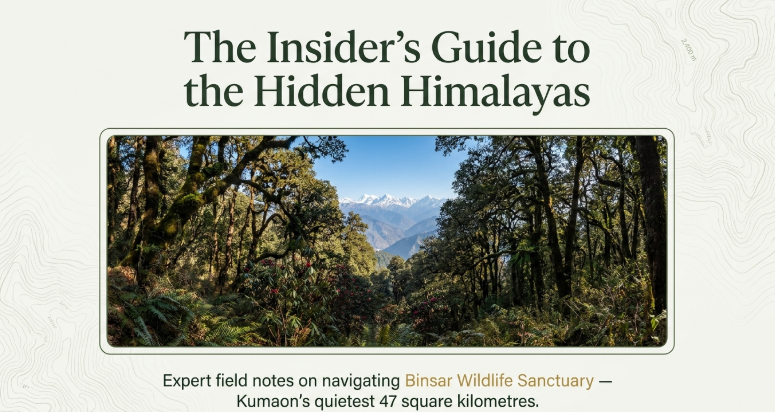
Places to Visit in Binsar 2026 — Wildlife, Views & Forests
What are the best places to visit in Binsar in 2026?
The best places to visit in Binsar include the Zero Point viewpoint for the finest 300 km Himalayan panorama in the Kumaon region, the Binsar Wildlife Sanctuary forest trails for leopard, barking deer and over 200 bird species, the Khali Estate heritage property, Binsar Mahadev temple, and the surrounding Kumaon oak and rhododendron forest that covers the entire sanctuary at 2,400 metres. Binsar sits in Almora district of Uttarakhand — one of the most undervisited wildlife sanctuaries in the Indian Himalayas, combining Himalayan panoramic views, dense temperate forest, and genuine wilderness in a single compact protected area.
Quick Summary
| Parameter | Details |
|---|---|
| Location | Almora District |
| Altitude | 2,400 metres (Zero Point) |
| Best Time to Visit | March–June & September–November |
| Known For | 300 km Himalayan panorama, leopard sightings, birdwatching, oak forest |
| Nearest Town | Almora (30 km) |
| Ideal Duration | 2–4 days |
| Type of Destination | Wildlife sanctuary, nature, heritage, Himalayan views |
Why Binsar Is the Most Underrated Wildlife Destination in Kumaon
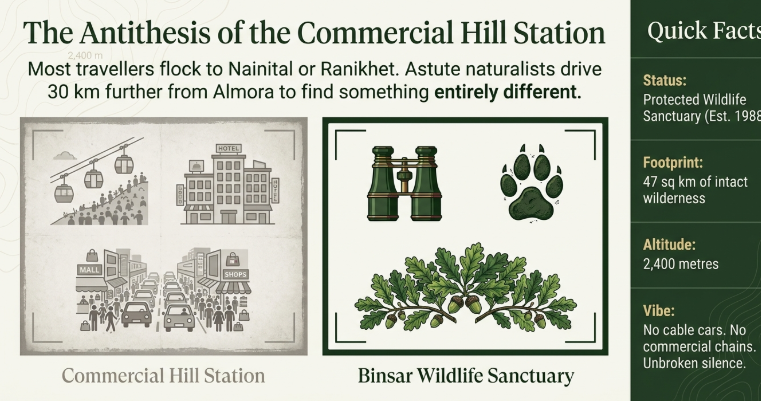
Most Kumaon travellers know Nainital. Some know Kausani and Ranikhet. Very few make the 30 km drive from Almora to Binsar — and almost everyone who does immediately understands why Binsar has maintained a loyal following among serious Uttarakhand travellers for decades.
Binsar is not a hill station. It is a wildlife sanctuary. A 47 sq km protected forest at 2,400 metres on the Jhandi Dhar ridge above Almora — home to leopard, Himalayan black bear, barking deer, musk deer, yellow-throated marten, and one of the finest concentrations of Himalayan bird species in the entire Kumaon region. The forest itself — dense oak, rhododendron, and horse chestnut — is among the finest examples of temperate Himalayan woodland accessible from any Kumaon hill town.
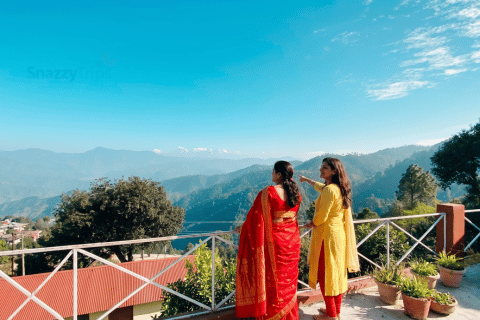
From the Zero Point viewpoint at the sanctuary's highest accessible point, on a clear morning between October and February, you can see simultaneously — Kedarnath, Trishul, Nanda Devi, the Panchachuli range, and peaks stretching into Nepal. The panorama is approximately 300 km wide. No other viewpoint accessible by road in the entire Kumaon Himalayas delivers this combined breadth and clarity.
And yet Binsar remains genuinely quiet. No cable cars. No commercial hotel chains inside the sanctuary. No organised tourist circuit. The visitors who come to Binsar come specifically — birdwatchers, wildlife photographers, people who have been to the obvious Kumaon destinations and are looking for something that still feels undiscovered.
As the best DMC in Uttarakhand with 21+ years of on-ground Kumaon expertise, SnazzyTrips has been taking serious Uttarakhand travellers to Binsar since 2003 — and this guide reflects everything learned from years of operating in this specific sanctuary.
1. Zero Point Viewpoint — The Finest Himalayan Panorama in Kumaon
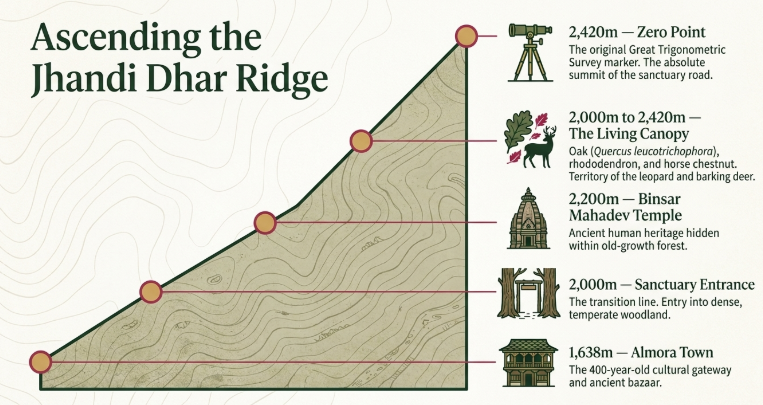
Distance from sanctuary entrance: 6 km inside the sanctuary Altitude: 2,420 metres Best time: 6:00am–8:00am on a clear morning Best months: October–February for maximum clarity
Zero Point is the single most significant reason to visit Binsar — and one of the finest viewpoints in the entire Indian Himalayas.
The name Zero Point refers to the original survey marker placed here during the Great Trigonometric Survey of India. From this position the surveyors had an unobstructed line of sight across the entire central Himalayan range — and that same unobstructed view remains today. No buildings. No telecoms towers. No light pollution. Just 300 km of snow-capped peaks arranged in a continuous arc from west to east.
What you can see from Zero Point on a clear day:
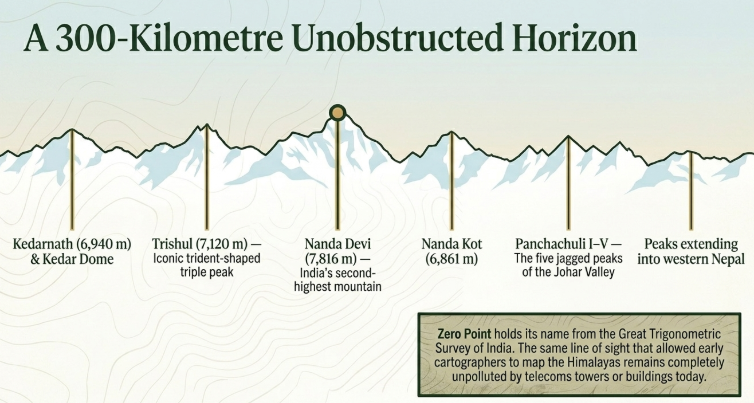
From west to east the panorama includes:
- Kedarnath (6,940 m) — the sacred Char Dham peak
- Kedar Dome and Kedarnath Dome
- Trishul (7,120 m) — the iconic trident-shaped triple peak
- Nanda Devi (7,816 m) — India's second-highest mountain, directly in the centre of the panorama
- Nanda Kot (6,861 m)
- Panchachuli I through V — the five peaks of the Johar Valley
- Peaks extending into far western Nepal on exceptionally clear days
The timing rule: Zero Point is extraordinary before 8:00am on a clear morning. By 10:00am cloud typically begins building from the valley. By noon the peaks are frequently partially or fully obscured. The entire Binsar experience pivots on being at Zero Point before 7:00am — a detail that every experienced Binsar operator knows and most generic travel agents do not.
Getting there: The road from the sanctuary entrance to Zero Point is 6 km through dense forest. Private vehicles are permitted inside the sanctuary on payment of a fee. Walking the 6 km is possible and recommended for birdwatching — the forest road sees more wildlife on foot than by vehicle.
2. Binsar Wildlife Sanctuary — Forest Trails and Wildlife
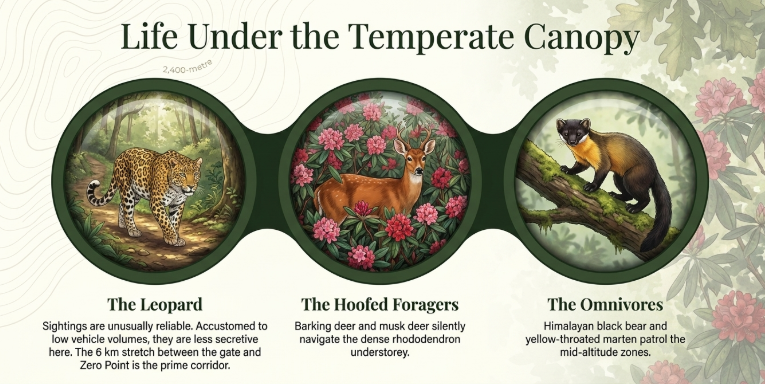
Area: 47 sq km Altitude range: 2,000–2,420 metres Key wildlife: Leopard, Himalayan black bear, barking deer, musk deer, yellow-throated marten Bird species: 200+ Best time for wildlife: Dawn and dusk year-round
The Binsar Wildlife Sanctuary is the reason this destination has a dedicated following among serious naturalists. The 47 sq km of protected temperate forest — primarily oak (Quercus leucotrichophora), rhododendron, horse chestnut, and maple — is one of the most intact examples of mid-altitude Himalayan woodland in the Kumaon region.
Leopard
Binsar is one of the most reliable locations in Uttarakhand for leopard sightings — not because the population is particularly dense but because the leopards here have become accustomed to the low volume of vehicles and walkers, making them less secretive than in more heavily visited sanctuaries. Dawn drives along the forest road between the sanctuary entrance and Zero Point consistently produce the highest sighting frequency.
Birds
With over 200 recorded species, Binsar is considered one of the premier birdwatching destinations in the Kumaon Himalayas. Key species include:
- Himalayan monal pheasant — the national bird of Nepal and state bird of Uttarakhand — regularly seen on the forest trails at dawn
- Khalij pheasant — common in the dense understorey
- Koklass pheasant — vocal but more secretive
- Himalayan woodpecker and great spotted woodpecker
- Blue whistling thrush — heard constantly in the forest stream areas
- Various Himalayan laughingthrushes, nuthatches, and warblers
October and November are the finest months for birdwatching at Binsar — winter species arrive from higher altitudes and the deciduous oaks lose their leaves, making birds far more visible than in the dense summer canopy.
Forest Walks
The network of forest trails radiating from the Zero Point road are among the finest walking routes in the Kumaon region. The most rewarding for wildlife and forest character:
- The Zero Point road on foot — 6 km each way, passing through three distinct forest zones
- The trail toward Khali Estate — through the densest section of the oak forest with excellent bird density
- The ridge walk beyond Zero Point — continuing east along the Jhandi Dhar ridge with expanding valley views
3. Binsar Mahadev Temple — Ancient Shiva Shrine in the Forest
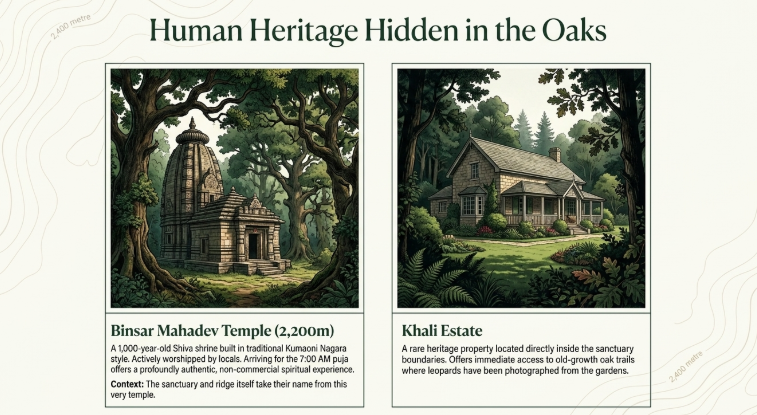
Distance from Zero Point: 4 km inside the sanctuary Altitude: 2,200 metres Best time: Early morning puja — 7:00am–8:00am
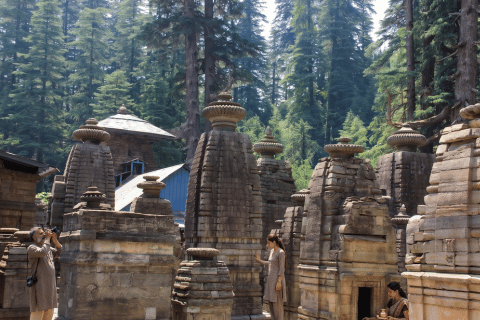
The Binsar Mahadev temple is an ancient Shiva shrine set deep in the sanctuary forest — believed to be over 1,000 years old, built in the Nagara architectural style characteristic of Kumaon hill temples. The temple complex sits in a forest clearing surrounded by enormous oak trees and gives no advance warning of its presence — you are walking through dense forest and suddenly arrive at a working temple that has been here for a millennium.
The temple is actively worshipped — local Kumaoni communities from surrounding villages visit regularly, and the morning puja atmosphere has a completely different quality from the tourist-facing temple experiences at more commercially developed Uttarakhand destinations.
What makes this temple significant: The Binsar Mahadev temple gives its name to the entire sanctuary area — the forest and ridge were named Binsar after this shrine. The local mythology connecting the temple to the surrounding forest is maintained by the resident priests and gives the visit a depth of context that purely scenic Himalayan destinations cannot offer.
4. Khali Estate — Heritage at the Heart of the Sanctuary
Location: Inside the Binsar Wildlife Sanctuary Type: Heritage forest property Best for: Couples, nature photographers, solo travellers seeking quiet
The Khali Estate is a heritage property set inside the Binsar Wildlife Sanctuary — one of the very few accommodation options within the sanctuary boundary itself. The property's location means wildlife visits the surrounding garden regularly — leopard has been photographed from the estate grounds, and the bird activity around the property at dawn is exceptional.
Even for non-staying visitors, the Khali Estate area represents the finest section of the sanctuary for the combination of forest character, Himalayan views, and wildlife probability. The approach road through the estate passes through old-growth oak forest that has the quality of something genuinely ancient.
5. Almora — The Gateway City Worth Staying In
Distance from Binsar: 30 km Altitude: 1,638 metres What to combine: Jageshwar temple, Chitai Golu Devta, Kasar Devi
Binsar is 30 km from Almora — close enough to combine meaningfully in a single itinerary. Almora's 400-year-old bazaar, the Chitai Golu Devta temple, and the Kasar Devi ridge are all within easy reach of a Binsar base.
The most natural Binsar itinerary uses 2 nights at Binsar for Zero Point and wildlife, and 2 nights at Almora for the cultural circuit — covering both the finest Himalayan panorama in Kumaon and the finest cultural heritage destination in the region.
📍 Quick Fact: Binsar Wildlife Sanctuary was established in 1988 and covers 47 sq km on the Jhandi Dhar ridge in Almora district. The sanctuary's altitude range of 2,000–2,420 metres places it entirely in the temperate oak-rhododendron forest zone — making it one of the most intact examples of this specific Himalayan forest type remaining in the Kumaon region.
6. Sunrise and Sunset Views — Beyond Zero Point
Best sunrise location: Zero Point (4 km from sanctuary gate) Best sunset location: The ridge road between Zero Point and Khali Estate Best months for both: October–February
Binsar offers two completely distinct Himalayan light experiences — sunrise from Zero Point and sunset from the eastern ridge — both worth planning your day around.
Sunrise at Zero Point: The east-facing aspect of Zero Point means the Himalayan peaks light up directly in front of you as the sun rises behind you. The sequence — dark silhouettes turning deep blue, then pink, then gold, then brilliant white — takes approximately 45 minutes from first light to full illumination. On a clear October morning this is one of the finest mountain sunrise experiences in the Indian Himalayas.
Sunset from the ridge: The western aspect of the Binsar ridge gives views toward the Kedarnath and Trishul groups at sunset — the western peaks catching the last light while the eastern range falls into shadow. Less dramatic than the sunrise but deeply atmospheric, particularly in October when the deciduous oaks have started turning and the forest colour adds warmth to the light.
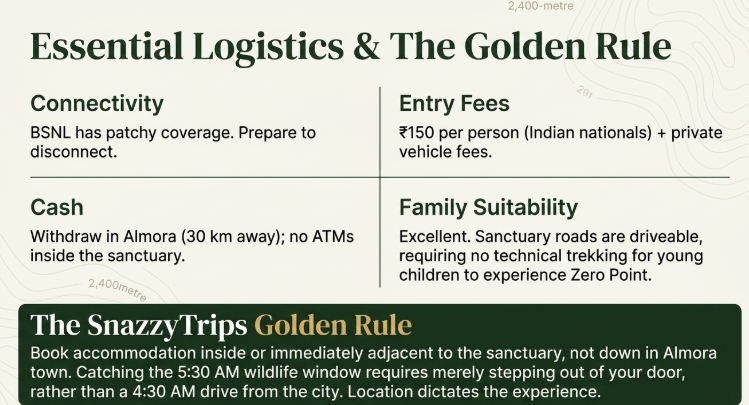
🧭 Traveller Tip: Book accommodation inside or immediately adjacent to the Binsar Wildlife Sanctuary — not in Almora town. The dawn wildlife window at Binsar requires you to be on the forest road by 5:30am. From Almora that means a 4:30am departure. From inside the sanctuary you simply walk out of your accommodation into the forest. The difference in wildlife probability is significant.
🏔️ SnazzyTrips Insights — What Years at Binsar Has Taught Us
Our teams have operated Binsar packages for over two decades — and the insight that consistently transforms the Binsar experience for our travellers is this: Binsar has two completely different personalities depending on when you arrive at Zero Point, and most visitors only ever meet one of them.
The Zero Point that most day-trippers see — arriving at 10:00am or 11:00am after driving up from Almora — is a pleasant viewpoint with partial or obscured Himalayan views. The mountains are there, somewhere behind the growing cloud, but the drama is gone.
The Zero Point that our travellers see — arriving at 6:15am after a pre-dawn departure from the sanctuary guesthouse — is a completely different place. Still, cold, absolutely silent, the entire Himalayan arc from Kedarnath to Panchachuli lit in the first morning light with no cloud anywhere. On the best October mornings we have seen this view from Zero Point and genuinely struggled to think of a more complete Himalayan panorama accessible to a non-technical traveller anywhere in India.
The second insight: the forest road between the sanctuary gate and Zero Point on foot at dawn is consistently the best wildlife zone in the sanctuary. Our teams walk this road before breakfast on every Binsar visit — monal pheasant on the trail, barking deer in the understorey, and occasionally leopard tracks in the road dust that tell you something passed through during the night.
Explore our Binsar tour packages to plan a visit built around the 6:00am Zero Point — not the 10:00am one.
Best Time to Visit Binsar in 2026 — Month by Month
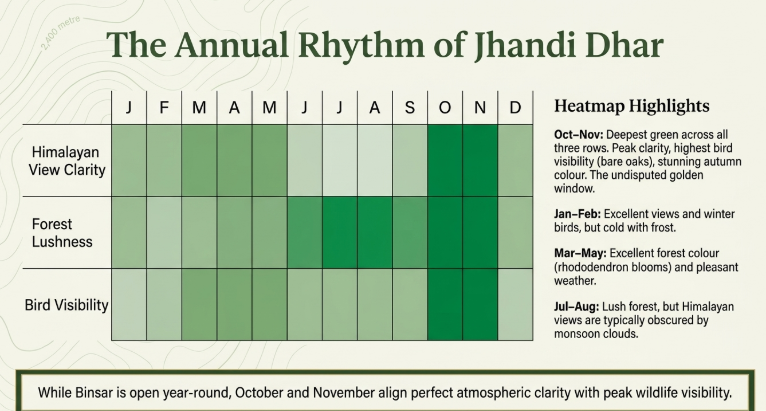
| Month | Weather | Suitability | Best For |
|---|---|---|---|
| Jan–Feb | Cold, possible frost | ⭐⭐⭐⭐ Very Good | Clearest Himalayan views, winter birds |
| March | Warming, rhododendrons starting | ⭐⭐⭐⭐ Very Good | Forest colour beginning, good views |
| April | Rhododendrons peak, clear views | ⭐⭐⭐⭐⭐ Excellent | Finest forest colour + clear panorama |
| May | Pleasant, excellent views | ⭐⭐⭐⭐⭐ Excellent | Best overall window |
| June | Pre-monsoon build-up | ⭐⭐⭐⭐ Very Good | Good conditions, last clear month |
| July–Aug | Monsoon — lush forest | ⭐⭐⭐ Moderate | Forest beautiful, views often obscured |
| September | Post-monsoon clarity | ⭐⭐⭐⭐⭐ Excellent | Clear views return, forest lush |
| October | Peak clarity, autumn colour | ⭐⭐⭐⭐⭐ Excellent | Best birdwatching, finest panorama |
| November | Crisp, winter birds arriving | ⭐⭐⭐⭐⭐ Excellent | Winter species, deciduous oaks bare |
| December | Cold, quiet | ⭐⭐⭐⭐ Very Good | Clear views, very few visitors |
Best months overall: October and November — the deciduous oaks lose their leaves making birds dramatically more visible, winter species arrive from higher altitudes, and the Himalayan views reach peak clarity in the cold dry air.
Binsar Wildlife Sanctuary Entry and Practical Information
Entry fee: ₹150 per person for Indian nationals (subject to change — verify before visiting) Vehicle fee: Additional charge for private vehicles entering the sanctuary Opening time: Sanctuary open sunrise to sunset Accommodation inside: Limited — Khali Estate and KMVN Binsar tourist rest house Nearest ATM: Almora town — carry sufficient cash before entering sanctuary Mobile network: Patchy inside the sanctuary — BSNL has limited coverage
Binsar With Family — What Works Best
Binsar is excellent for families with children who enjoy nature — the forest walks, the bird spotting, and the Zero Point sunrise are all accessible experiences. The sanctuary road is driveable, meaning families with young children can experience the forest and the viewpoint without any trekking requirement.
For families combining Binsar with other Kumaon destinations, the Nainital Binsar 4 nights 5 days package from SnazzyTrips covers both destinations seamlessly — Nainital for the lake and hill town experience, Binsar for the wildlife and Himalayan panorama.
Binsar Combined With Other Destinations
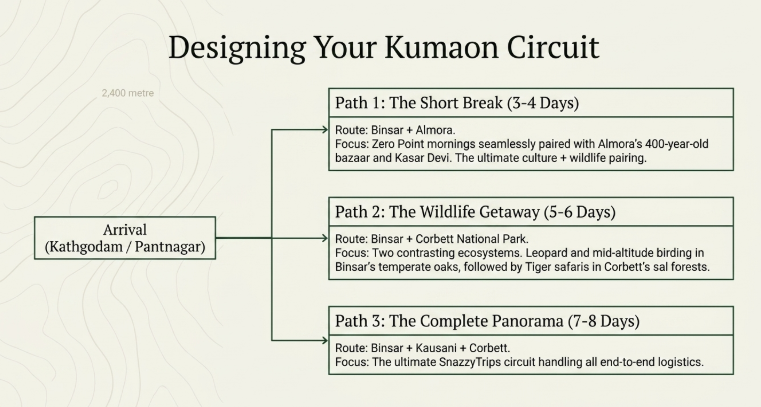
Binsar + Almora (3–4 days) The most natural combination — Binsar for Zero Point and wildlife, Almora for the bazaar, Jageshwar, and Kasar Devi. Complementary destinations 30 km apart covering wildlife and culture in a single trip.
Binsar + Kausani + Corbett (7–8 days) One of the finest complete Kumaon circuits. Binsar for Himalayan views and wildlife, Kausani for the tea estate and 300 km panorama, Corbett for tiger safari. Our Binsar Kausani Corbett tour package covers this full circuit with all logistics handled end to end.
Binsar + Corbett Wildlife Getaway For dedicated wildlife enthusiasts — Binsar for leopard and birdwatching in the sanctuary forest, Corbett for tiger safari. Two completely different wildlife ecosystems in one trip. The Corbett Binsar wildlife getaway package combines both in a single seamless itinerary.
Binsar From Major Indian Cities
Binsar draws a significant number of visitors from western and southern India — particularly from Mumbai, Pune, and Kerala — who appreciate its combination of wildlife, Himalayan views, and genuine forest character.
For travellers from Mumbai, our Binsar tour package from Mumbai includes flight connections to Pantnagar or Dehradun and full ground transfers. The Binsar tour package from Pune and Binsar tour package from Kerala follow the same structure — making what seems like a complex mountain journey into a single seamless booking.
For a straightforward Kathgodam-based departure, the Binsar 2 nights 3 days package from Kathgodam is the most efficient way to experience Zero Point and the sanctuary wildlife in a focused short break.
Frequently Asked Questions
Q: What are the best places to visit in Binsar in 2026?
A: The five best places in Binsar are Zero Point viewpoint for the 300 km Himalayan panorama — best at 6:00am before cloud builds — the sanctuary forest trails for leopard and 200+ bird species, Binsar Mahadev ancient Shiva temple in the forest, Khali Estate heritage property and grounds, and the ridge walk beyond Zero Point for sunset Himalayan views. All five are covered in SnazzyTrips Binsar packages. Explore our Binsar tour packages for full itinerary options.
Q: What wildlife can I see in Binsar Wildlife Sanctuary?
A: Binsar Wildlife Sanctuary is home to leopard, Himalayan black bear, barking deer, musk deer, yellow-throated marten, and over 200 bird species including the Himalayan monal pheasant, khalij pheasant, koklass pheasant, blue whistling thrush, and various Himalayan woodpeckers. Leopard sightings are relatively reliable on the dawn forest road between the sanctuary gate and Zero Point. October and November are the finest months for birdwatching when deciduous oaks lose their leaves and winter species arrive.
Q: What is the best time to visit Binsar in 2026?
A: October and November are the finest months overall — the deciduous oak forest becomes open and birdwatching reaches its peak, winter species arrive from higher altitudes, and the Himalayan panorama from Zero Point reaches maximum clarity in the cold dry air. April–May is equally good for the rhododendron bloom and clear views. Avoid July–August when monsoon rain frequently obscures the Himalayan panorama.
Q: How far is Binsar from Nainital and Almora?
A: Binsar is 30 km from Almora — approximately 60–75 minutes by cab on the mountain road to the sanctuary entrance. From Nainital, Binsar is approximately 95 km — around 3 hours. Most itineraries use Almora as the overnight base for Binsar day visits, or stay inside the sanctuary at Khali Estate or the KMVN rest house for the pre-dawn Zero Point experience.
Q: Is Binsar good for families with children?
A: Yes — Binsar is excellent for families who enjoy nature. The sanctuary road is driveable making Zero Point accessible without any trekking. Wildlife spotting from the vehicle is engaging for children of all ages. The forest walks are suitable for children above 6 years. The Zero Point sunrise — even for young children — is a genuine wonder. For a combined family circuit, the Nainital Binsar package covers the lake town experience at Nainital with the wildlife and panorama at Binsar.
Q: What should I know before visiting Binsar Wildlife Sanctuary?
A: Carry sufficient cash before entering the sanctuary as there are no ATMs inside — the nearest is in Almora town. Entry fees apply for both visitors and vehicles. Accommodation inside the sanctuary is very limited — Khali Estate and KMVN rest house only — and must be booked well in advance. Mobile network inside the sanctuary is patchy with BSNL having limited coverage. Arrive at Zero Point before 7:00am for the clearest Himalayan views — cloud builds from mid-morning on most days.
Q: How do I find the right travel agent for Binsar?
A: Look for an agent who schedules Zero Point visits before 7:00am and includes a dawn forest walk as standard — these two details immediately reveal whether the agent has operated Binsar trips or is assembling a package from a desk. SnazzyTrips has been operating Binsar packages for over two decades with a 4.7/5 traveller rating. For a complete guide on evaluating any Uttarakhand travel agent, the best travel agent for Uttarakhand 2026 guide covers every checkpoint in detail.
Plan Your Binsar Visit With SnazzyTrips
Zero Point at 6:15am on a clear October morning. The entire Himalayan arc from Kedarnath to Panchachuli lit in first light. No cloud. No other visitors. The sound of the forest below. This is why Binsar has a dedicated following — and why every first-time visitor immediately starts planning their return.
SnazzyTrips has been operating Binsar packages since 2003. As the best DMC in Uttarakhand for Kumaon wildlife and nature travel — for both direct travellers and 150+ travel agent partners — we bring 21 years of Binsar-specific knowledge to every booking we take.
Travel Packages