Kausani Attractions & Places to Visit in Uttarakhand
Kausani Attractions & Places to Visit in Uttarakhand
What are the best places to visit in Kausani in 2026?
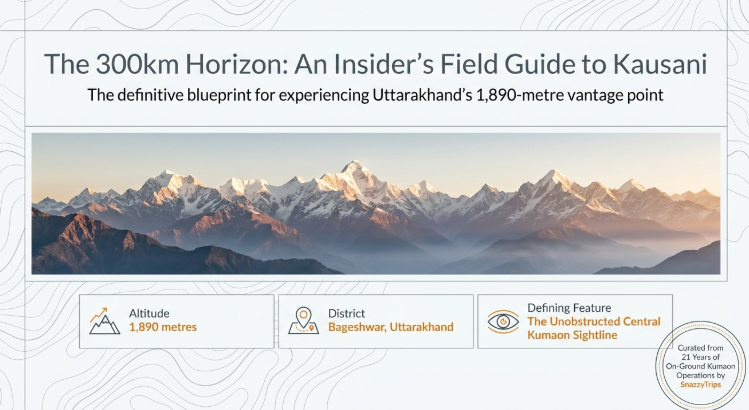
The best places to visit in Kausani include the Kausani sunrise viewpoint for the 300 km Himalayan panorama including Trishul and Nanda Devi, the Uttarakhand Tea Estate for organic green tea plantation tours, Anasakti Ashram where Mahatma Gandhi stayed for 14 days in 1929, Baijnath temple complex 16 km away with 12th-century Shiva carvings, Rudradhari Falls and caves, Lakshmi Ashram, and the Sumitranandan Pant Gallery. Kausani sits at 1,890 metres in Bageshwar district of Uttarakhand — a quiet hill town whose 300 km Himalayan panorama prompted Gandhi to call it the Switzerland of India during his 1929 visit.
Quick Summary
| Parameter | Details |
|---|---|
| Location | Bageshwar District |
| Altitude | 1,890 metres |
| Best Time to Visit | March–June & September–November |
| Known For | 300 km Himalayan panorama, organic tea estate, Anasakti Ashram (Gandhi Ashram) |
| Nearest Railhead | Kathgodam (117 km) |
| Ideal Duration | 3–5 days |
| Type of Destination | Hill station, heritage, nature, pilgrimage |
Why Kausani Is the Hill Station That Stopped Gandhi in His Tracks
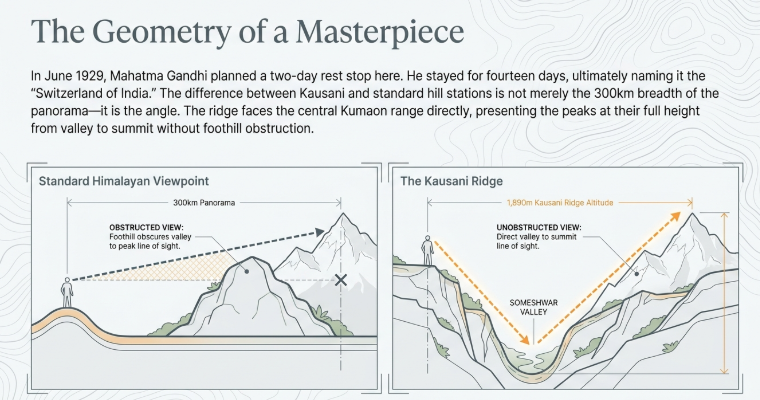
In June 1929, Mahatma Gandhi arrived at Kausani for what was planned as a two-day rest stop on his way through the Kumaon hills. He stayed for fourteen days.
He wrote later that the Himalayan panorama from Kausani was so extraordinary — the peaks of Trishul, Nanda Devi, and Panchachuli arranged across the horizon in a continuous arc of snow and rock — that he could not bring himself to leave. He wrote his commentary on the Bhagavad Gita during those fourteen days. He called the view the Switzerland of India.
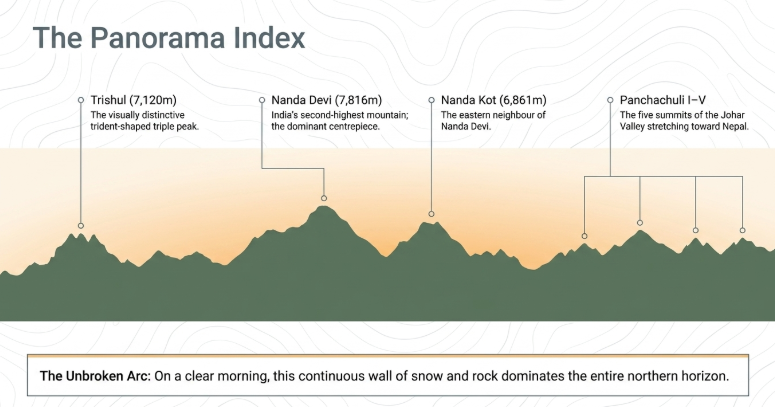
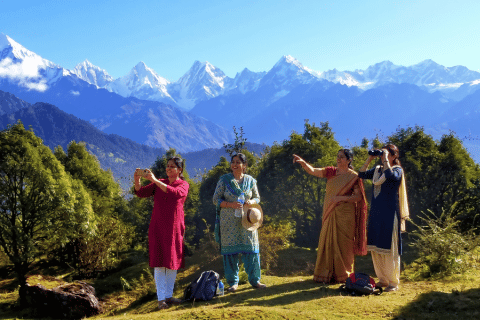
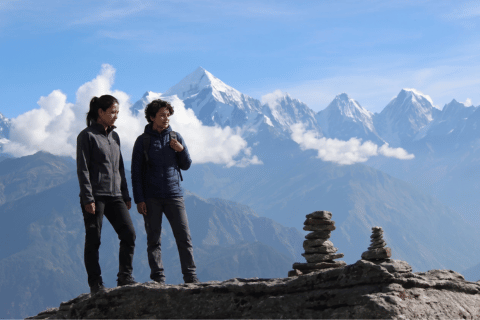
The view from Kausani has not changed. The peaks are still there — Trishul at 7,120 metres, Nanda Devi at 7,816 metres, the five Panchachuli summits stretching toward Nepal. On a clear morning between 5:30 and 7:00 the panorama is as complete and as overwhelming as anything Gandhi described. The difference between Kausani and most Himalayan viewpoints is not just the breadth of what you see. It is the angle. The Kausani ridge faces the central Kumaon Himalayan range directly — the peaks rise from the valley without obstruction, presenting themselves at full height across the entire northern horizon.
Most travellers who visit Kausani spend one night and leave feeling they missed something. They did. Kausani rewards three nights — two chances at the sunrise panorama, one full day for the tea estate and the Baijnath temple, one afternoon for the Anasakti Ashram and the Rudradhari walk.
As the best DMC in Uttarakhand with 21+ years of on-ground Kumaon expertise, SnazzyTrips has been building Kausani itineraries around this philosophy since 2003. This guide is what two decades of operating in this specific hill town looks like in writing.
1. Kausani Sunrise Viewpoint — The Panorama That Stopped Gandhi
Location: Above the main Kausani bazaar — multiple viewpoints along the ridge Best time: 5:30am–7:00am Difficulty: Easy — flat ridge road, no trekking Best months: October–February for maximum clarity
The Kausani sunrise viewpoint is not a single spot — it is the entire northern edge of the Kausani ridge, where the hill town drops away to the Someshwar valley and the Himalayan range rises without interruption on the northern horizon.
What you see on a clear morning:
From west to east the panorama runs:
- Trishul (7,120 m) — the trident-shaped triple peak, most visually distinctive of all
- Nanda Devi (7,816 m) — India's second-highest mountain, the dominant peak of the central panorama
- Nanda Kot (6,861 m) — east of Nanda Devi
- Panchachuli I through V — the five Johar Valley peaks named after the five Pandavas
- Various Kumaon foothills and river valleys visible in the middle distance
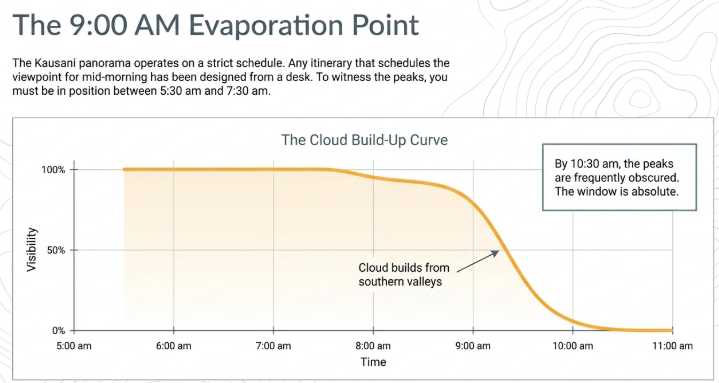
The timing rule: The Kausani panorama is clearest between 5:30am and 7:30am. By 9:00am on most days cloud begins building from the southern valleys. By 10:30am the peaks are frequently partially obscured. Any Kausani itinerary that schedules the panorama viewpoint for mid-morning has been designed from a desk by someone who has never seen Kausani at 6:00am.
The north-facing room rule: The panorama is only visible from north-facing positions on the ridge. Hotels on the south-facing slope have valley views — pleasant but not what Kausani is famous for. Every genuine Kausani travel agent confirms north-facing room orientation before booking. This single detail determines whether you experience the panorama from your room at 5:30am or have to walk to a public viewpoint.
The tea estate framing: The most beautiful Kausani sunrise photographs are taken from above the tea estate terraces — the green plantation rows in the foreground with the Himalayan range behind. This specific composition requires knowing which section of the ridge gives you the tea garden in the foreground. Our team knows it precisely.
2. Uttarakhand Tea Estate — India's Highest Organic Tea Plantation
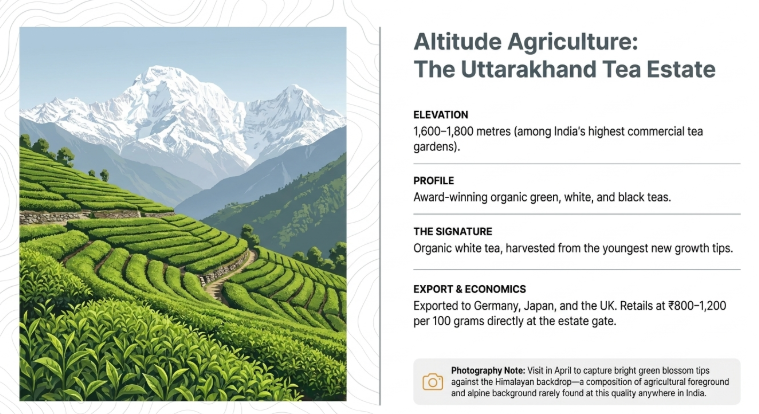
Distance from bazaar: 1 km below the main Kausani viewpoint Best time: Morning plantation tours — 7:00am–10:00am Guided tour duration: 1–1.5 hours Advance booking: Recommended for guided tours — slots are limited
The Uttarakhand Tea Estate is Kausani's most distinctive experience — and the one most often reduced to a quick photograph from the road rather than the immersive plantation tour it deserves.
The estate grows tea at 1,600–1,800 metres — one of the highest commercial tea-growing altitudes in India. The plantation produces organic green, white, and black teas that have won national quality awards and are exported to Europe and Japan. The tea bushes here — some planted over 50 years ago — grow in terraced rows along the north-facing slope with the Himalayan range rising directly above.
The guided plantation tour includes:
- Walk through the tea garden rows with a plantation guide
- Explanation of the altitude-specific growing conditions that produce the distinctive Kausani flavour profile
- The withering, rolling, and drying process shown in the processing facility
- Tea tasting — typically 3–4 varieties including the estate's signature white tea
- Direct purchase from the estate at prices significantly below what the same tea costs in Nainital or Delhi
What to know: The estate is run by the Uttarakhand Tea Development Board — a government enterprise. Tours are genuine and educational rather than commercially polished. The guide speaks Hindi and basic English. Mornings are best — the processing facility is most active between 8:00am and 11:00am when fresh leaf is being processed.
Photography note: The tea estate in April blossom season — when new growth covers the bushes in bright green tips — against the Himalayan backdrop is one of the finest compositions in the Kumaon Himalayas. This combination of agricultural foreground and Himalayan background is rare at this quality anywhere in India.
3. Anasakti Ashram — Where Gandhi Wrote the Gita Commentary
Distance from bazaar: 500 metres from the main Kausani viewpoint Best time: Early morning — 6:30am–8:00am Entry: Free — donations welcome Time required: 45 minutes–1 hour
The Anasakti Ashram — named for Gandhi's concept of non-attachment, anasakti — is the building where Gandhi stayed during his 14-day Kausani visit in 1929. It is now maintained as a museum and active ashram, with the original rooms preserved and open to visitors.
What to see here:
- Gandhi's original room — preserved exactly as it was during his 1929 stay, with period photographs and his writing desk
- The Himalayan view terrace — the specific position where Gandhi sat and looked at the panorama that kept him here for two weeks
- The ashram library — containing Gandhi's Gita commentary written here and a collection of his works
- Morning prayers — held at 6:30am in the main prayer hall. Attending these — a small group of ashram residents and occasional visitors, chanting in the quiet of early morning with the Himalayan range visible through the window — is one of the most unexpectedly moving experiences in Kausani
The historical significance: Gandhi did not just rest at Kausani. His commentary on the Bhagavad Gita — Anasakti Yoga — was written here. This document, written while looking at the Himalayan panorama, became one of his most significant philosophical texts. The connection between the view from this ridge and the writing produced here gives Kausani a specific intellectual and spiritual resonance that most hill stations do not have.
4. Baijnath Temple Complex — 12th-Century Shiva Shrine on the Gomti River
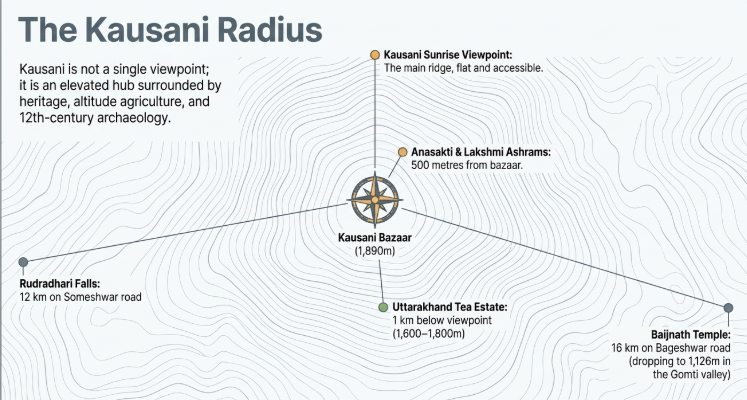
Distance from Kausani: 16 km on the Bageshwar road Altitude: 1,126 metres (Gomti River valley) Best time: 8:00am–11:00am Time required: 2–3 hours Difficulty: Easy — flat temple complex
Baijnath is one of the most significant and least visited archaeological and spiritual sites in the entire Kumaon Himalayas — and the experience that most Kausani itineraries miss entirely.
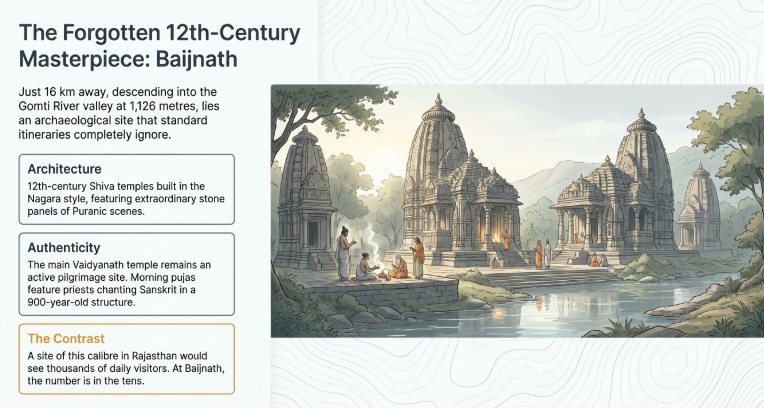
The Baijnath temple complex sits on the banks of the Gomti River — a group of ancient Shiva temples built in the 12th century in the Nagara architectural style with carved stone panels depicting scenes from the Puranas and Mahabharata. The stone carving quality here — particularly the panels on the exterior walls of the main Vaidyanath temple — is among the finest medieval temple sculpture in Uttarakhand.
What makes Baijnath significant:
- The main Vaidyanath (Shiva as the Lord of Physicians) temple is an active pilgrimage site — morning puja with priests chanting Sanskrit in a 900-year-old temple is as authentic a sacred experience as Uttarakhand offers
- The river setting — the Gomti flowing past the temple ghats with the forested Kumaon hills above — is photographically extraordinary in the morning light
- Almost no tourists. A site of this archaeological significance at a comparable location in Rajasthan would be receiving thousands of visitors daily. At Baijnath the number is in the tens.
- The carved stone panels around the temple exterior could occupy a serious student of Indian art for hours
Practical notes: The 16 km drive from Kausani to Baijnath descends through some of the finest forest scenery in the Bageshwar district. The road follows the Gomti River for the final 5 km — past traditional Kumaoni stone houses, terraced fields, and the kind of road that makes the journey as rewarding as the destination.
5. Rudradhari Falls and Caves — The Hidden Forest Walk
Distance from Kausani: 12 km on the Someshwar road Best time: September–November (post-monsoon peak flow) Difficulty: Easy to Moderate — 2 km forest walk Time required: 3–4 hours round trip
Rudradhari Falls is a waterfall and ancient Shiva cave temple reached via a 2 km forest walk from the Someshwar road — completely absent from most standard Kausani itineraries and one of the finest half-day walks in the Bageshwar district.
The trail passes through a mixed oak and rhododendron forest that is one of the finest birdwatching corridors in the Kausani area. The falls — multiple cascades dropping through a narrow rock gorge — reach their most dramatic in September and October when post-monsoon flow is at maximum. The cave temples at the base of the falls have been in active worship for centuries.
Why most agents skip it: The Rudradhari walk requires a driver who knows the turn-off from the Someshwar road — it is not well-signposted. The trail has two forks where local knowledge is needed. And the walk back is uphill. Generic operators who have never done this specific walk leave it out. Genuine Kausani specialists include it as a standard half-day excursion.
6. Best Offbeat Places Near Kausani
Gwaldam (36 km) A quiet meadow town at 1,950 metres with arguably the finest apple orchards in the Kumaon Himalayas and a Himalayan view that many photographers consider superior to Kausani itself. Almost no tourists. One guesthouse. Perfect for a half-day excursion from Kausani or an overnight extension.
Baijnath (16 km) Already covered above — but worth noting it is the most important offbeat destination near Kausani and the one that rewards travellers with genuine historical curiosity most specifically.
Someshwar Valley The valley below Kausani at 900 metres — traditional Kumaoni villages, terraced paddy fields, and the Kosi River — is accessible as a late afternoon drive with completely different scenery from the ridge. The contrast between the sub-tropical valley and the alpine ridge above is one of Kausani's less-appreciated geographic assets.
Lakshmi Ashram (500 metres from Kausani bazaar) Founded in 1948 by an English disciple of Gandhi — Catherine Mary Heilemann, known as Sarala Devi — the ashram continues Gandhi's vision of rural self-sufficiency. The resident community of women practices traditional Kumaoni crafts, farming, and weaving. A visit here gives a genuinely different perspective on Kausani's philosophical heritage.
📍 Quick Fact: The Uttarakhand Tea Estate at Kausani produces tea at altitudes between 1,600 and 1,800 metres — making it one of the highest altitude commercial tea gardens in India. The estate's organic white tea — harvested from the youngest new growth tips — has been exported to Germany, Japan, and the UK and retails at ₹800–1,200 per 100 grams at the estate gate.
7. Sumitranandan Pant Gallery — Kausani's Literary Heritage
Location: In Kausani bazaar Entry: Nominal fee Time required: 30–45 minutes
Sumitranandan Pant — one of the most celebrated poets of Hindi literature and a winner of the Jnanpith Award, India's highest literary honour — was born in Kausani in 1900. The gallery in his honour occupies his birth home and contains manuscripts, photographs, personal belongings, and a collection of his published works.
Pant's nature poetry — deeply influenced by the Himalayan landscape he grew up in — is considered some of the finest writing about the natural world in any Indian language. For travellers interested in Indian literature or the specific relationship between place and creative work, this gallery offers context that transforms how you look at the Kausani panorama.
🧭 Traveller Tip: Stay in Kausani for a minimum of three nights — not two. One night gives you one sunrise attempt. If that morning is cloudy, you leave without experiencing the panorama Kausani is famous for. Two nights gives you two attempts. Three nights gives you the sunrise, the full Baijnath day, the tea estate morning, the Rudradhari walk, and the Anasakti Ashram at dawn prayers — which together constitute the complete Kausani experience.
🏔️ SnazzyTrips Insights — 21 Years of Kausani Operations
Our teams have been operating Kausani packages for over two decades — and the insight that consistently makes the difference between a memorable Kausani trip and a disappointing one is this: the sunrise panorama at Kausani is a weather-dependent experience. It is not guaranteed. And one night in Kausani does not give you enough attempts.
We have seen travellers arrive at Kausani having planned a single night — check in at 3pm, see the viewpoint at 5:30am the next morning, leave by 10am. On a clear October morning that schedule works. On a morning when low cloud sits on the Himalayan range — which happens roughly 40% of the time even in October — they leave having seen a white wall where the peaks should be.
We always recommend a minimum of three nights at Kausani. Three mornings gives you a statistical near-certainty of at least one clear panorama. It also gives you time for the tea estate tour, the Baijnath excursion, and the Anasakti Ashram dawn prayers — none of which can be rushed or skipped without losing a significant part of what makes Kausani worth visiting.
A second operational insight specific to the tea estate: the morning tour between 8:00am and 10:00am during April–June is the only time you can observe the fresh leaf processing — the most interesting part of the tour. Any visit outside this window sees the factory idle. We schedule the tea estate as the second activity of the morning — after the sunrise viewpoint and before the day heats up.
Explore our Kausani tour packages to plan your visit with the timing intelligence that two decades of operating here produces.
Best Time to Visit Kausani in 2026 — Month by Month
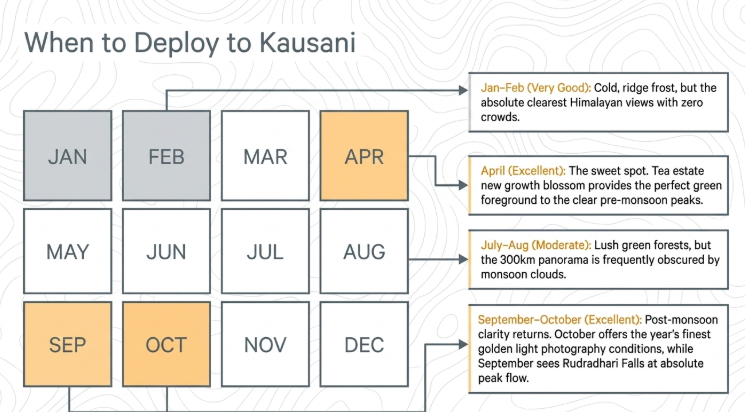
| Month | Weather | Suitability | Best For |
|---|---|---|---|
| Jan–Feb | Cold, possible frost on ridge | ⭐⭐⭐⭐ Very Good | Clearest Himalayan views, very few tourists |
| March | Warming, rhododendrons starting | ⭐⭐⭐⭐ Very Good | Forest colour beginning, good panorama |
| April | Tea estate blossom, clear views | ⭐⭐⭐⭐⭐ Excellent | New tea growth — finest estate photography |
| May | Clear skies, comfortable temperatures | ⭐⭐⭐⭐⭐ Excellent | Best overall window before monsoon |
| June | Pre-monsoon build-up | ⭐⭐⭐⭐ Very Good | Last clear month — tea harvest season |
| July–Aug | Monsoon — lush green | ⭐⭐⭐ Moderate | Forest beautiful, panorama often obscured |
| September | Post-monsoon clarity returns | ⭐⭐⭐⭐⭐ Excellent | Rudradhari Falls at peak, clear views |
| October | Finest clarity, golden light | ⭐⭐⭐⭐⭐ Excellent | Best photography month of the year |
| November | Crisp, cold, quiet | ⭐⭐⭐⭐ Very Good | Very few tourists, excellent panorama |
| December | Cold, quiet, budget-friendly | ⭐⭐⭐ Good | Peaceful off-season visit |
Best months: April–May and September–October. April for the tea estate new growth and clear pre-monsoon panorama. October for the year's clearest skies and finest photography conditions.
Places to Stay in Kausani — What to Know
Kausani accommodation divides into two categories that determine your entire experience:
North-facing ridge properties: These face the Himalayan range directly. The panorama is visible from your room window — or from the property terrace — at 5:30am without leaving the building. This category typically carries a 25–40% premium over equivalent south-facing properties but delivers the defining Kausani experience. Every SnazzyTrips Kausani package confirms north-facing orientation before booking.
South-facing or valley-facing properties: Comfortable, often well-priced, but without the Himalayan panorama that is the entire reason most people visit Kausani. The view from these properties is the forested Someshwar valley — pleasant but not what Kausani is famous for.
The most important question to ask any Kausani travel agent: Can you confirm that my hotel faces north toward the Himalayan range? If they cannot answer this question definitively — they do not have direct hotel relationships in Kausani.
Kausani Distance — How to Reach
From Kathgodam: 117 km — approximately 4–5 hours via Almora and Someshwar. The most common approach for travellers from Delhi using the Ranikhet Express train (arrives Kathgodam 5:45am).
From Almora: 52 km — approximately 2 hours. Almora is the natural intermediate stop for travellers combining Kausani with Jageshwar and the wider Kumaon circuit. For planning the Almora portion, the travel agent in Almora 2026 guide covers what to look for before booking.
From Nainital: 117 km — approximately 4 hours via Bhowali and Almora.
From Delhi by road: 415 km — approximately 9–10 hours direct.
Kausani as Part of the Kumaon Circuit
Kausani works beautifully as part of a wider Kumaon circuit — its central position in the district makes it a natural connecting point for several of the region's best destinations.
Kausani + Nainital + Ranikhet + Almora (7 days) The classic Kumaon circuit — combining lake town, cantonment hill station, cultural heritage, and Himalayan panorama in a single loop. Our Nainital Ranikhet Almora Kausani 7 days 6 nights package from Kathgodam covers the full circuit with seamless transfers.
Kausani + Munsiyari + Binsar + Nainital (10 days) For travellers who want to add high-altitude trekking at Munsiyari and wildlife at Binsar to the Kausani panorama experience. The 10-day Munsiyari Kausani Binsar Nainital package is one of SnazzyTrips' most requested complete Kumaon itineraries.
Kausani + Nainital + Binsar (7 days) A shorter Kumaon circuit combining the lake town, the tea estate panorama, and the wildlife sanctuary. The Nainital Binsar Kausani 7 days 6 nights package covers this circuit efficiently.
Kausani + Binsar + Corbett (7–8 days) A nature-focused circuit — Kausani for the panorama and tea estate, Binsar for leopard and birdwatching, Corbett for tiger safari. The Binsar Kausani Corbett tour package combines all three.
Frequently Asked Questions
Q: What are the best places to visit in Kausani in 2026?
A: The seven best places in Kausani are the sunrise viewpoint for the 300km Himalayan panorama best seen at 5:30am, the Uttarakhand Tea Estate for organic plantation tours, Anasakti Ashram where Gandhi wrote his Gita commentary, Baijnath temple 16km away for 12th-century Shiva carvings on the Gomti River, Rudradhari Falls and caves via a forest walk, Gwaldam meadow town 36km away, and the Sumitranandan Pant Gallery. All seven are covered in our best travel agent in Kausani guide with specific timing and logistics for each.
Q: What are the best places to visit in Kausani in winter 2026?
A: Kausani in winter — November to February — offers the year's clearest Himalayan panorama in the cold dry air, the Anasakti Ashram morning prayers in complete quiet, the Baijnath temple at its most atmospheric in the winter morning light, and the tea estate in its dormant season with the pruned bushes creating graphic patterns against the snow peaks. January and February are the least-visited months — the panorama is frequently spectacular and you have the ridge largely to yourself.
Q: What are the best places to visit near Kausani — offbeat options?
A: The finest offbeat places near Kausani are Gwaldam at 36km — a quiet apple orchard meadow town with arguably superior Himalayan views and almost no tourists — and the Someshwar Valley below Kausani at 900 metres, accessible as an afternoon drive through traditional Kumaoni villages and terraced paddy fields. The Rudradhari Falls forest walk, while technically within the Kausani circuit, is also unknown to most visitors and deserves to be on every itinerary.
Q: What is the best time to visit Kausani?
A: April–May and September–October are the two peak windows. April gives you the tea estate at its most photogenic — new growth tips on every bush against the Himalayan backdrop — with pre-monsoon clarity on the panorama. October delivers the year's clearest Himalayan views with the best photography conditions. Avoid single-night visits in any season — the weather-dependent panorama requires at least three nights for a statistically reliable clear morning experience.
Q: What are the 10 best places to visit in Kausani?
A: The 10 best places in and around Kausani are the sunrise viewpoint, Uttarakhand Tea Estate, Anasakti Ashram, Baijnath temple complex, Rudradhari Falls and caves, Gwaldam meadow town, Lakshmi Ashram, Sumitranandan Pant Gallery, Someshwar Valley drive, and the Kausani bazaar at 7:00am before the day begins. Together these ten constitute a complete Kausani experience that rewards five days rather than the one or two nights most travellers allow.
Q: How far is Kausani from Nainital and Kathgodam?
A: Kausani is 117 km from both Nainital and Kathgodam — approximately 4–5 hours drive via Almora. From Delhi the distance is 415 km by road — approximately 9–10 hours. The Ranikhet Express overnight train from Delhi Anand Vihar arrives at Kathgodam at 5:45am — the most comfortable option for travellers from Delhi or NCR.
Q: What are the things to do in Kausani 2026?
A: The best things to do in Kausani are the 5:30am Himalayan panorama viewing from the north ridge, the guided organic tea plantation tour at the Uttarakhand Tea Estate, dawn prayers at Anasakti Ashram, the full-day Baijnath temple excursion, the Rudradhari Falls forest walk, the Gwaldam half-day extension, and birdwatching on the forested approach to Rudradhari. For planning any of these with genuine local knowledge, the best travel agent for Uttarakhand 2026 guide covers what to look for in a Kumaon specialist before booking.
Plan Your Kausani Visit With SnazzyTrips
Kausani at 5:30am on a clear October morning. The entire Himalayan arc from Kedarnath to Panchachuli lit in first light. Trishul turning from silhouette to silver to gold. The tea estate terraces below you still in shadow. This is the Kausani that kept Gandhi for fourteen days — and the Kausani that makes travellers come back.
Getting this experience requires the right hotel facing, the right number of nights, the right timing for the tea estate, and a travel agent who has been there enough times to know what to do if your first morning is cloudy.
SnazzyTrips has been planning Kausani holidays since 2003. As the best DMC in Uttarakhand for Kumaon travel — serving both direct travellers and 150+ travel agent partners — we bring 21 years of Kausani-specific knowledge to every booking.
Travel Packages