Places to Visit in Mukteshwar 2026 — Orchards, Cliffs & Views

Places to Visit in Mukteshwar 2026 — Orchards, Cliffs & Views
What are the best places to visit in Mukteshwar in 2026?
The best places to visit in Mukteshwar include the Mukteshwar Temple viewpoint for the 300 km Himalayan panorama at 2,286 metres, Chauli Ki Jali — the dramatic cliff edge with Nanda Devi directly opposite — the Mukteshwar Inspection Bungalow viewpoint, the apple and pear orchards of the IVRI research campus, Bhalu Gaad waterfall, Peora village area for the finest fruit orchard landscape in Kumaon, and the dense oak and rhododendron forest trails of the surrounding Nainital Forest Division. Mukteshwar sits at 2,286 metres in Nainital district of Uttarakhand — a former British research station whose combination of high-altitude orchard landscapes, dramatic cliff views, and Himalayan panoramas makes it one of the most visually distinctive hill stations in the Kumaon region.
Quick Summary
| Category | Details |
|---|---|
| Location | Nainital District, Uttarakhand |
| Altitude | 2,286 metres |
| Best Time to Visit | March–June & September–November |
| Known For | Chauli Ki Jali cliffs, 300km Himalayan panorama, apple orchards |
| Nearest Railhead | Kathgodam (63 km) |
| Ideal Duration | 3–5 days |
| Type of Destination | Hill station, nature, orchards, heritage |
Why Mukteshwar Is the Hill Station Serious Kumaon Travellers Choose
There is a version of Uttarakhand travel that most visitors experience — Nainital for the lake, Mussoorie for the Mall Road, Ranikhet for the cantonment. These are legitimate, enjoyable destinations. They are also among the most visited hill stations in India and carry the crowds, the commercial infrastructure, and the diluted atmosphere that very high visitor volumes inevitably produce.
Mukteshwar is what Kumaon was before mass tourism arrived.
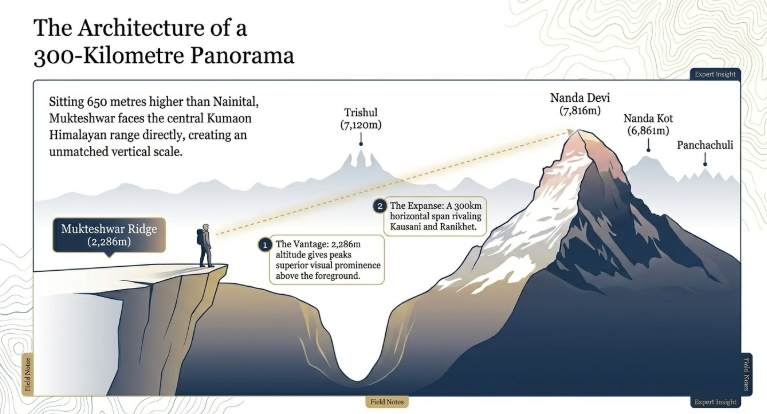
Sitting at 2,286 metres — 650 metres higher than Nainital — on a ridge that faces the central Kumaon Himalayan range directly, Mukteshwar has the finest altitude-adjusted climate of any accessible Kumaon hill station. The temperature in May, when Nainital is warm and busy, is still cool enough for comfortable walking all day. In October, when the rest of Kumaon is at peak visitor capacity, Mukteshwar is quiet, clear, and extraordinary.
The landscape here is specifically distinctive — apple and pear orchards planted across steep south-facing slopes during the British research station era, dense oak and rhododendron forest on the northern aspects, dramatic cliff edges overlooking deep valleys, and the Himalayan range — Nanda Devi, Trishul, Panchachuli — visible across the full northern horizon in a panorama that rivals anything Kausani or Ranikhet delivers.
Most travellers who discover Mukteshwar do so by accident — as an overnight stop between Nainital and Kausani, or as a recommendation from someone who has been to Kumaon before. Almost all of them wish they had come specifically and stayed longer.
As the best DMC in Uttarakhand with 21+ years of on-ground Kumaon expertise, SnazzyTrips has been building Mukteshwar itineraries since 2003. This guide reflects everything learned from two decades of operating in this specific hill town. If you are also evaluating operators for your Mukteshwar trip, our best travel agent in Mukteshwar guide covers exactly what to look for before you book.
1. Chauli Ki Jali — The Cliff Edge That Defines Mukteshwar
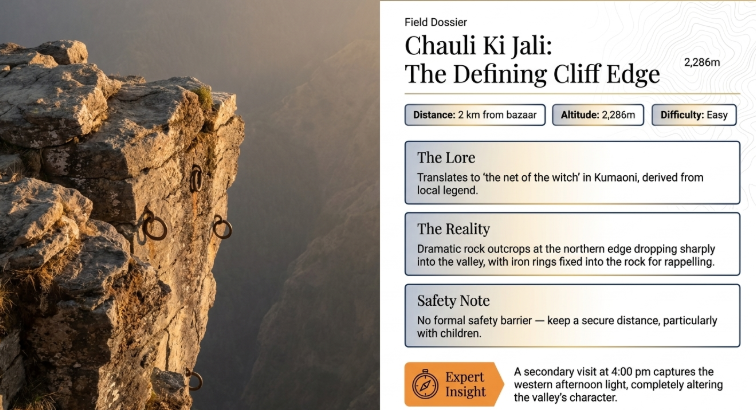
Distance from town: 2 km from Mukteshwar bazaar Altitude: 2,286 metres Best time: Dawn (5:30am–7:00am) and late afternoon (4:00pm–6:00pm) Difficulty: Easy — short walk from the road Time required: 1.5–2 hours
Chauli Ki Jali is the single most distinctive experience Mukteshwar offers — and the one that separates it most clearly from every other Kumaon hill station.
The name means "the net of the witch" in Kumaoni — derived from a local legend about a witch who was captured in a net at this cliff edge. What it actually is: a series of dramatic rock outcrops and cliff faces at the northern edge of the Mukteshwar ridge, dropping sharply into the valley below while Nanda Devi rises directly opposite across the gorge. The visual geometry here is unique — you stand at the cliff edge at 2,286 metres with the valley floor far below and Nanda Devi at 7,816 metres directly in your line of sight. The vertical scale is extraordinary.
What makes Chauli Ki Jali unique:
The cliff face itself has iron rings fixed into the rock — used for rappelling and rock climbing by groups with proper equipment. But the view from the cliff edge — no ropes required — is the experience that draws most visitors. The combination of the drop below, the valley width, and Nanda Devi filling the northern skyline directly opposite creates a visual drama that flat ridge viewpoints cannot replicate.
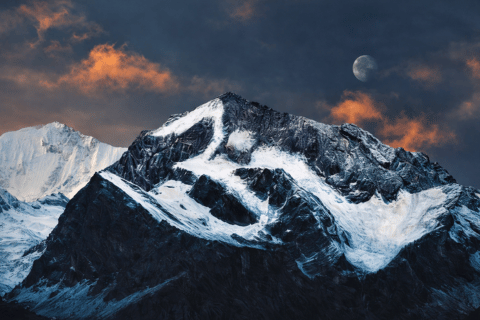
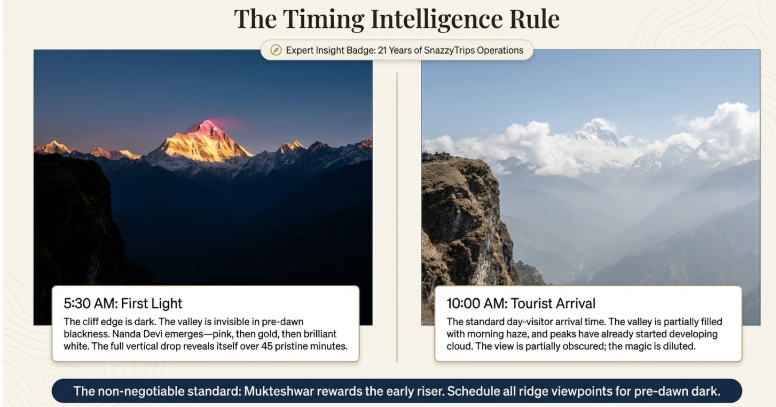
Sunrise at Chauli Ki Jali: Arriving at 5:30am when the cliff edge is still in pre-dawn dark and watching Nanda Devi emerge from darkness and gradually light up — from deep blue to pink to brilliant white — while the valley below remains in shadow is one of the finest mountain experiences available from any accessible point in the Kumaon Himalayas.
Practical notes:
- The 2 km walk from the bazaar passes through good birdwatching forest — start early
- The cliff edge has no formal safety barrier — keep a safe distance from the edge, particularly with children
- Rock climbing and rappelling is possible with equipment — contact local operators in Mukteshwar bazaar
- The same cliff at 4:00pm catches the western afternoon light differently from the morning — a second visit at different times of day is worthwhile
2. Mukteshwar Temple Viewpoint — Ancient Shiva Shrine and Himalayan Panorama

Distance from town: 500 metres from Mukteshwar bazaar Best time: 5:30am–7:00am for sunrise panorama Entry: Free Time required: 1–1.5 hours
The Mukteshwar Temple — dedicated to Lord Shiva and believed to be over 350 years old — sits at the highest point of the Mukteshwar ridge with a terrace viewpoint that delivers what many experienced Himalayan travellers consider the finest accessible ridge-top panorama in the Nainital district.
From the temple terrace at 2,286 metres on a clear morning you can see simultaneously:
- Nanda Devi (7,816 m) — dominant and central
- Trishul (7,120 m) — the trident triple peak to the west
- Nanda Kot (6,861 m) — to the east of Nanda Devi
- Panchachuli range — the five peaks of the Johar Valley
- Kedarnath — visible on the clearest October and November mornings
The panorama is approximately 300 km wide — comparable to Kausani and Ranikhet at their best, but delivered from a higher altitude that gives the peaks slightly more visual prominence above the foreground.
The temple experience: The 350-year-old Shiva shrine at the summit is an active temple — morning puja at approximately 6:30am is attended by local residents. Visiting the temple at dawn, combining the puja atmosphere with the Himalayan panorama emerging in first light, is one of the finest combined spiritual and scenic experiences in all of Kumaon.
Architecture: The temple complex is built in the Nagara style typical of Kumaon hill shrines — compact, stone-built, with carved elements that have weathered 350 years of Himalayan climate. The surrounding forest and the cliff edge visible below the temple complex add a dramatic natural setting that most accessible hilltop temples in India cannot match.
3. Mukteshwar Inspection Bungalow Viewpoint

Distance from town: 1 km from bazaar Best time: Morning — 6:00am–8:00am Difficulty: Easy Time required: 45 minutes–1 hour
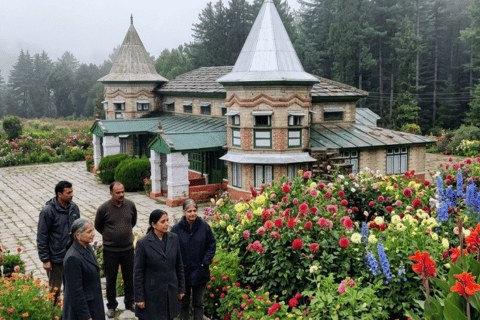
The Mukteshwar Inspection Bungalow is a British-era government rest house — one of the finest examples of colonial hill station architecture remaining in the Nainital district — with a garden terrace that delivers one of the most complete Himalayan panoramas in Mukteshwar.
The bungalow garden is publicly accessible for the viewpoint. The terrace sits on the northern ridge edge with unobstructed views of the Himalayan range above the orchard valley. This is the Mukteshwar viewpoint that most serious Himalayan photographers use specifically — the combination of the old bungalow architecture in the foreground and the Himalayan peaks above makes it the finest compositional opportunity in the area.
Practical note: The Inspection Bungalow is also available for overnight accommodation through the Public Works Department — one of the most atmospheric budget accommodation options in Mukteshwar for travellers who appreciate colonial-era heritage stays at minimal cost.
4. The Apple and Pear Orchards — Mukteshwar's Defining Landscape
Location: Throughout the Mukteshwar ridge and slopes Best time: April (blossom) / August–September (harvest) Time required: 1–2 hour orchard walk
The orchard landscape of Mukteshwar is what makes it visually distinctive from every other Kumaon hill station. Apple and pear orchards were planted across the south-facing slopes surrounding Mukteshwar during the British research station era — the Indian Veterinary Research Institute (IVRI) campus that was established here in 1898 included extensive horticultural experimentation alongside its veterinary work.
The result is a landscape that has no equivalent in accessible Kumaon — steep terraced slopes covered in fruit trees, their branches gnarled and twisted with age, the Himalayan range rising above the upper edge of the orchard and the valley dropping sharply below the lower edge.
The two orchard seasons:
April blossom: Apple and pear trees in simultaneous white and pale pink blossom, the flowers covering every branch against a background of the northern forest. On a clear April morning with Nanda Devi above the blossom line this is the finest natural composition available in Mukteshwar — and one of the finest orchard landscapes in the Indian Himalayas.
August–September harvest: The blossom replaced by fruit — green and red apples, yellow pears — bending the branches against the backdrop of the monsoon-lush valley. The fruit is sold directly from roadside stands and orchard gates at prices significantly below what the same produce commands in Nainital or Delhi.
The orchard walk: The road from Mukteshwar bazaar toward Peora village (10 km) passes through the finest section of the orchard landscape. Walking this road in the morning — particularly between 7:00am and 9:00am when the light comes from behind the walker toward the peaks — is one of the finest unstructured walks available at any Kumaon hill station.
5. Bhalu Gaad Waterfall — The Hidden Forest Cascade

Distance from Mukteshwar: 6 km toward Ramgarh on the Ramgarh road Best time: September–November (post-monsoon peak flow) Difficulty: Moderate — rocky trail descent to the falls Time required: 2.5–3 hours round trip
Bhalu Gaad is a waterfall on the Bhalu Gaad stream — a tributary of the Kosi River — that drops through a series of cascades in a narrow forest gorge approximately 6 km from Mukteshwar toward Ramgarh. The falls are accessible via a rocky trail descent from the road — not immediately visible from any viewpoint, which is why most day-trippers never find them.
The waterfall is at its finest in September and October when post-monsoon flow is at maximum and the surrounding forest is still in full monsoon lushness. The combination of the water volume, the narrow gorge acoustics, and the dense oak forest surrounding the falls creates an atmosphere genuinely unlike the open ridge landscape of the main Mukteshwar viewpoints.
Why it is worth the effort: Most Mukteshwar experiences are visual — panoramas, cliff views, orchard compositions. Bhalu Gaad is a sensory experience — the sound of the falls in the gorge, the spray on the trail approach, the forest smell. For travellers spending 3–4 nights in Mukteshwar it provides a genuinely different experience from the ridge circuit.
Practical notes:
- The trail to the falls involves a rocky descent that can be slippery after rain — wear proper footwear
- A local guide is recommended — the trail approach is not clearly marked from the road
- The best photography light is mid-morning between 9:00am and 11:00am
- Not recommended for very young children or elderly travellers due to the rocky trail
6. Peora Village and Ramgarh — The Extended Orchard Circuit

Distance from Mukteshwar: 10 km (Peora) / 20 km (Ramgarh) Best time: April for blossom / August–September for harvest Time required: Half day to full day excursion
Peora is a small village 10 km from Mukteshwar on a ridge at approximately 2,000 metres — surrounded by some of the finest orchard landscapes in the entire Kumaon Himalayas and with Himalayan views that many serious photographers consider superior to the main Mukteshwar ridge.
Peora has almost no tourist infrastructure — a few homestays, a small market, traditional Kumaoni stone houses with slate roofs. The road from Mukteshwar to Peora passes through continuous orchard and forest landscape that is genuinely extraordinary in the blossom and harvest seasons.
Ramgarh — 20 km from Mukteshwar — was Tagore's retreat and is known for its orchard landscapes and literary heritage. The Kumaon Himalayas visible from the Ramgarh ridge on a clear morning have inspired some of the finest nature writing in Bengali literature. This combination of natural beauty and cultural heritage makes Ramgarh an excellent full-day extension from Mukteshwar.
📍 Quick Fact: Mukteshwar hosts the Indian Veterinary Research Institute (IVRI) campus — established in 1898 and one of India's oldest and most significant veterinary research institutions. The British chose this specific location because of its altitude, clean water, controlled climate, and distance from the disease vectors of the plains. The same factors that made it ideal for veterinary research also make it one of the finest hill station environments in Kumaon — cool, clean, and genuinely high-altitude in character.
7. Sitla Village and Estate — The Quiet Complement

Distance from Mukteshwar: 5 km Best time: Year-round — particularly fine in spring and autumn Type: Heritage estate and village circuit
Sitla is a small estate village 5 km from Mukteshwar — reached via a forest road through oak and rhododendron woodland. The village itself has a quiet, traditional Kumaoni character — stone houses, terraced fields, fruit trees — that the more visited sections of Mukteshwar have partially lost to tourism infrastructure.
The Sitla area is also one of the finest birdwatching zones accessible from Mukteshwar. The forest between Mukteshwar and Sitla is rich in Himalayan pheasant, Himalayan woodpecker, various flycatchers, and winter visitors that descend from higher altitudes in October and November.
8. Forest Walks — The Oak and Rhododendron Trail Network
Starting point: Multiple entry points around Mukteshwar bazaar Best time: April (rhododendron bloom) and October (golden oak light) Difficulty: Easy to Moderate Time required: 1–3 hours depending on route
Mukteshwar is surrounded by Nainital Forest Division protected woodland — oak, rhododendron, horse chestnut, and deodar — that is among the finest accessible forest at this altitude in the Nainital district. Unlike the more manicured forest walks at Ranikhet cantonment, the Mukteshwar forest has a wilder character — less maintained, more deeply atmospheric.
The best forest walks from Mukteshwar:
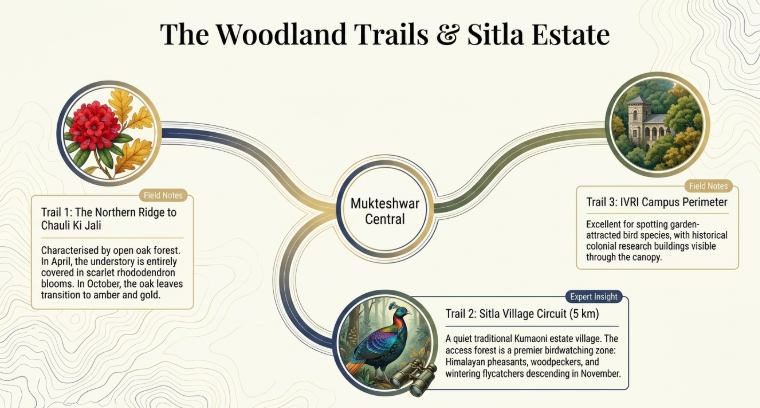
The ridge trail toward Chauli Ki Jali — Following the northern ridge from the bazaar toward the cliff edge through open oak forest. In April this trail is lined with rhododendron in full scarlet bloom. In October the oak leaves turn gold and amber.
The orchard-forest edge walk toward Peora — The lower trail below the road toward Peora follows the boundary between the orchard terraces and the forest above — one of the finest interfaces between cultivated and wild landscape in the Kumaon Himalayas.
The IVRI campus perimeter — The research institute campus perimeter road is excellent for birdwatching — the campus gardens attract species that the surrounding forest does not — and the old colonial research buildings visible through the trees add a historical character to the walk.
🧭 Traveller Tip: Stay in Mukteshwar for a minimum of three nights — not two. Night one gives you the sunset from Chauli Ki Jali. Morning two gives you the Mukteshwar Temple sunrise panorama. Day two gives you the Bhalu Gaad waterfall and the orchard walk. Day three gives you the Peora and Ramgarh extension. A two-night visit covers the temple viewpoint and Chauli Ki Jali — the most famous experiences. A three-night visit covers the orchard walks, the waterfall, and the village circuit that transforms a pleasant Mukteshwar trip into a complete one.
🏔️ SnazzyTrips Insights — 21 Years of Mukteshwar Operations
Our teams have been operating Mukteshwar packages for over two decades — and the insight that changes most Mukteshwar itineraries for the better is simply this: Chauli Ki Jali at dawn is a completely different experience from Chauli Ki Jali at 10:00am.
Most day visitors arrive at Chauli Ki Jali between 10:00am and 12:00pm — when the valley below is still partially filled with morning haze but the Himalayan peaks have already started to develop cloud. They get a partially obscured view, take photographs that do not capture what the place actually looks like, and leave feeling it was good but not spectacular.
Our travellers arrive at Chauli Ki Jali at 5:30am. The cliff edge is still dark. The valley below is completely invisible in pre-dawn blackness. And then Nanda Devi begins to emerge — first as a dark mass against a slightly lighter sky, then as the first light catches the summit snows and turns them pink, then gold, then white. The valley slowly becomes visible below. The full scale of the vertical drop and the horizontal panorama reveals itself over 45 minutes that most travellers describe as among the finest experiences of any Uttarakhand trip.
The same principle applies to the Mukteshwar Temple viewpoint — the 5:30am temple panorama versus the 10:00am temple panorama are genuinely different experiences. We schedule all Mukteshwar viewpoint visits at dawn as a non-negotiable standard in every package we operate.
Explore our Mukteshwar tour packages to plan your Mukteshwar visit with the timing intelligence that 21 years of operating here produces.
Best Time to Visit Mukteshwar in 2026 — Month by Month
| Month | Weather | Suitability | Best For |
|---|---|---|---|
| Jan–Feb | Cold, possible snowfall | ⭐⭐⭐⭐ Very Good | Snow on orchards, clearest Himalayan views |
| March | Warming, rhododendrons starting | ⭐⭐⭐⭐ Very Good | Forest colour beginning, good panorama |
| April | Orchard blossom peak | ⭐⭐⭐⭐⭐ Excellent | Apple and pear blossom — finest orchard month |
| May | Cool, clear, comfortable | ⭐⭐⭐⭐⭐ Excellent | Best overall window before monsoon |
| June | Pre-monsoon build-up | ⭐⭐⭐⭐ Very Good | Last clear month, good conditions |
| July–Aug | Monsoon — lush green | ⭐⭐⭐ Moderate | Forest beautiful, views variable |
| September | Post-monsoon clarity | ⭐⭐⭐⭐⭐ Excellent | Bhalu Gaad peak flow, clear views |
| October | Finest clarity, golden light | ⭐⭐⭐⭐⭐ Excellent | Best photography, finest Himalayan panorama |
| November | Crisp, very quiet | ⭐⭐⭐⭐ Very Good | Apple harvest, low crowds |
| December | Cold, orchard bare | ⭐⭐⭐ Good | Snow possible, budget rates |
Best months: April and October. April for the orchard blossom against the clear pre-monsoon Himalayan backdrop. October for the year's finest Himalayan clarity and golden orchard harvest light.
Mukteshwar With Family — What Works Best
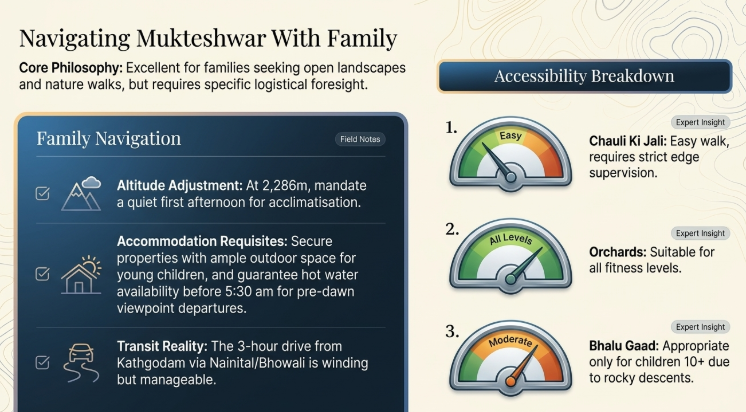
Mukteshwar is excellent for families who enjoy nature walks and open landscapes. Chauli Ki Jali is accessible for all ages — the cliff edge requires supervision with young children but the viewpoint and the walk there are entirely manageable. The orchard walks are suitable for all fitness levels. Bhalu Gaad is appropriate for children above 10 with the rocky trail descent.
Key family considerations:
- The altitude at 2,286 metres is the highest of any commonly visited Nainital district hill station — allow a quiet first afternoon for adjustment
- The road from Kathgodam to Mukteshwar via Nainital takes approximately 3 hours — manageable for families
- Accommodation with outdoor space — important for families with young children who need room to move
- Hot water before 5:30am — essential for early Chauli Ki Jali and temple viewpoint departures
Mukteshwar vs Nainital — Which to Choose?
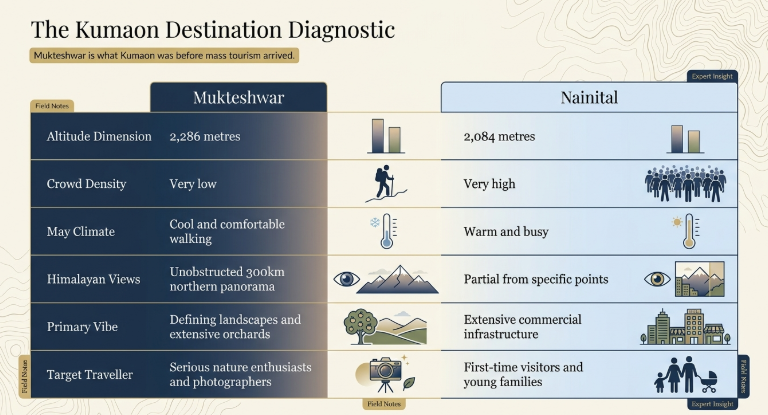
A question many travellers ask when planning a first Kumaon trip:
| Factor | Mukteshwar | Nainital |
|---|---|---|
| Altitude | 2,286 m | 2,084 m |
| Crowds | Very low | Very high |
| Climate in May | Cool and comfortable | Warm and busy |
| Himalayan Views | 300km panorama | Partial from specific points |
| Orchards | Extensive and defining | Limited |
| Family Accessibility | Moderate | Very Easy |
| Best For | Serious nature travellers, photographers | First-time visitors, families |
| Commercial Infrastructure | Minimal | Extensive |
The honest answer: Nainital for first-time Uttarakhand visitors and families with very young children. Mukteshwar for travellers who have been to Nainital, know what they want from Kumaon, and are looking for something quieter, higher, and more dramatically beautiful.
How to Reach Mukteshwar
From Kathgodam: 63 km — approximately 2.5–3 hours via Bhowali. The road from Bhowali to Mukteshwar climbs continuously through forest and orchard landscape — some of the finest approach road scenery of any Kumaon hill station.
From Nainital: 51 km — approximately 2 hours via Bhowali.
From Delhi: 330 km — approximately 7–8 hours by road. The overnight Ranikhet Express from Delhi Anand Vihar arrives at Kathgodam at 5:45am — then approximately 3 hours by cab to Mukteshwar, arriving mid-morning.
Our Mukteshwar trip from Delhi package covers full transfers from Delhi including the Kathgodam pickup option.
Mukteshwar as Part of the Kumaon Circuit
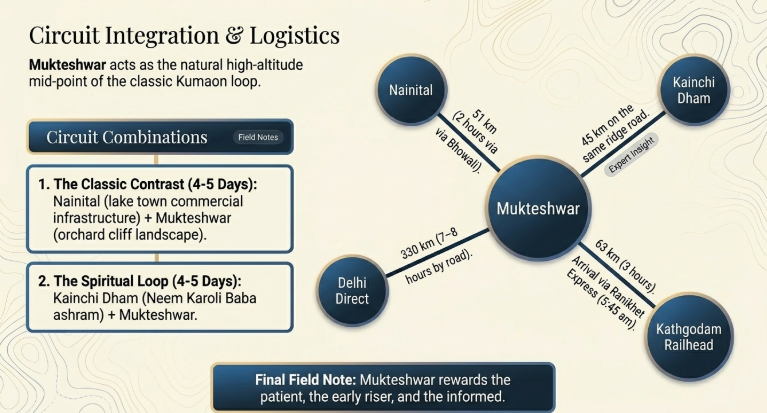
Mukteshwar works exceptionally well as part of a wider Kumaon circuit — its position between Nainital and Kausani makes it the natural mid-point of the classic Kumaon loop.
Mukteshwar + Nainital (4–5 days) The most natural short combination — Nainital for the lake town experience, Mukteshwar for the orchard cliff landscape and high-altitude panorama. Our Nainital Mukteshwar package from Ahmedabad covers this combination with full flight connections and ground transfers.
Kainchi Dham + Mukteshwar (4–5 days) For spiritually inclined travellers who want to combine the Neem Karoli Baba ashram experience at Kainchi Dham with the high-altitude landscape of Mukteshwar. Both are in the Nainital district and sit 45 km apart on the same Kumaon ridge road. The best travel agent for Kainchi Dham guide covers the Kainchi Dham planning in detail.
Frequently Asked Questions
Q: What are the best places to visit in Mukteshwar in 2026?
A: The eight best places in Mukteshwar are Chauli Ki Jali cliff edge for the most dramatic viewpoint in Kumaon best seen at 5:30am, the Mukteshwar Temple for the 350-year-old Shiva shrine and 300km Himalayan panorama, the apple and pear orchards in April blossom and September harvest, the Inspection Bungalow viewpoint for the finest compositional photography in the area, Bhalu Gaad waterfall for a forest cascade experience, Peora village for the finest offbeat orchard landscape, Sitla estate for birdwatching and quiet village character, and the oak and rhododendron forest trail network surrounding the town. SnazzyTrips Mukteshwar tour packages cover all eight with expert dawn timing built into every itinerary.
Q: What is Chauli Ki Jali and why is it famous?
A: Chauli Ki Jali is a series of dramatic cliff outcrops at the northern edge of the Mukteshwar ridge at 2,286 metres — where the ground drops sharply into a deep valley and Nanda Devi at 7,816 metres rises directly opposite. The name means "the net of the witch" in Kumaoni from a local legend. It is famous for the vertical scale of the view — cliff drop below, Nanda Devi directly opposite at full height — and for rock climbing and rappelling activities. Visited at 5:30am as the first light hits Nanda Devi across the valley it is considered one of the finest Himalayan viewpoint experiences in accessible Kumaon.
Q: What is the best time to visit Mukteshwar in 2026?
A: April and October are the two finest months. April gives you the apple and pear orchards in simultaneous blossom with clear pre-monsoon Himalayan views — one of the most beautiful natural compositions in Kumaon. October delivers the year's clearest Himalayan panorama with golden orchard harvest light and the lowest crowd levels of the accessible travel season. Avoid July and August when views are frequently obscured by monsoon cloud.
Q: Is Mukteshwar better than Nainital?
A: They serve different traveller profiles. Nainital is ideal for first-time Kumaon visitors and families with young children — extensive infrastructure, lake activities, and a well-developed tourist circuit. Mukteshwar is the choice for travellers who have been to Nainital and want something quieter, higher, and more dramatically scenic — the orchard landscape, the Chauli Ki Jali cliffs, and the 300km Himalayan panorama are experiences that Nainital simply does not offer. Many travellers combine both destinations in a single Kumaon itinerary.
Q: How far is Mukteshwar from Nainital and Kathgodam?
A: Mukteshwar is 51 km from Nainital — approximately 2 hours by cab via Bhowali. From Kathgodam the distance is 63 km — approximately 2.5 to 3 hours. From Delhi by road the distance is 330 km — approximately 7 to 8 hours. The Ranikhet Express overnight train from Delhi Anand Vihar arrives at Kathgodam at 5:45am — then 3 hours to Mukteshwar, arriving mid-morning.
Q: What are the offbeat places near Mukteshwar?
A: The finest offbeat places near Mukteshwar are Peora village at 10 km for the most unspoiled orchard landscape in the Kumaon Himalayas, Ramgarh at 20 km for orchard scenery and Tagore's literary heritage, Sitla estate at 5 km for birdwatching and traditional Kumaoni village character, and the Bhalu Gaad waterfall trail for a forest gorge experience that most visitors to the area never find. All four reward travellers willing to go slightly beyond the main Mukteshwar viewpoint circuit.
Q: Can I do rock climbing at Chauli Ki Jali?
A: Yes — the cliff faces at Chauli Ki Jali have fixed iron rings for rappelling and rock climbing. This requires proper equipment and an experienced local operator — do not attempt without both. The viewpoint experience at the cliff edge is entirely accessible without any climbing equipment and does not require adventure experience. Local operators in Mukteshwar bazaar can arrange guided rappelling sessions with equipment. Costs typically range from ₹500–1,500 per person for a guided session.
Q: How do I find the right travel agent for Mukteshwar?
A: Ask whether they schedule Chauli Ki Jali at dawn rather than mid-morning — this single question immediately reveals whether the agent has operated Mukteshwar trips or simply listed the destination. A genuine Mukteshwar specialist also knows the Peora road, the Bhalu Gaad trail approach, and the specific April blossom timing in the IVRI campus orchards. For a complete framework on choosing the right Uttarakhand travel agent, the best travel agent for Uttarakhand 2026 guide covers every checkpoint in detail.
Plan Your Mukteshwar Visit With SnazzyTrips
Mukteshwar at 5:30am — Chauli Ki Jali in pre-dawn dark, the valley completely invisible below, Nanda Devi beginning to emerge from darkness as a dark shape against a slightly lighter sky. Then the first light on the summit snows. Then the pink, and the gold, and the white. And below you the valley revealing itself slowly as the light builds — forests, orchards, the Kosi River far below.
This is what Mukteshwar is. Not a comfortable mid-range hill station between Nainital and Kausani. A specific landscape of orchards and cliffs and Himalayan views that rewards the traveller who arrives at the cliff edge before the sun does.
SnazzyTrips has been planning Mukteshwar holidays since 2003. As the best DMC in Uttarakhand for Kumaon travel — serving both direct travellers and 150+ travel agent partners — we bring 21 years of Mukteshwar-specific knowledge to every booking.
Travel Packages