Places to Visit in Munsiyari 2026 — Hidden Himalayan Gems
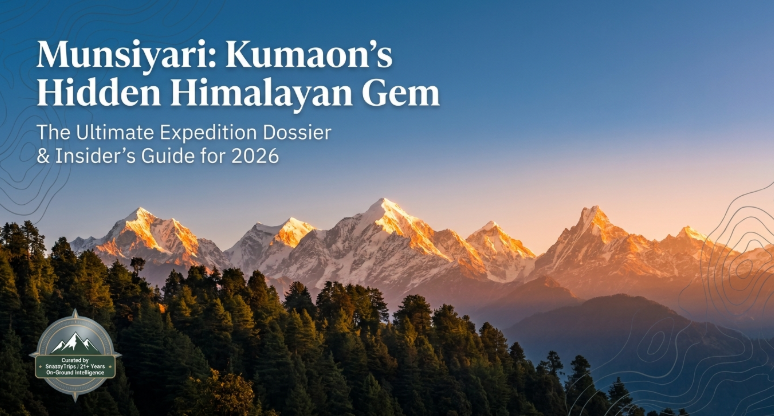
Places to Visit in Munsiyari 2026 — Hidden Himalayan Gems
What are the best places to visit in Munsiyari in 2026?
The best places to visit in Munsiyari include the Panchachuli peaks viewpoint, Khaliya Top meadow, Thamri Kund sacred lake, Birthi Falls, Darkot village, the Tribal Heritage Museum, and the Milam Glacier approach trail. Munsiyari sits at 2,200 metres in Pithoragarh district of Uttarakhand — the last major town before the restricted Himalayan zone — and offers some of the finest mountain panoramas, high-altitude treks, and Shauka cultural experiences in the entire Kumaon region.
Quick Summary
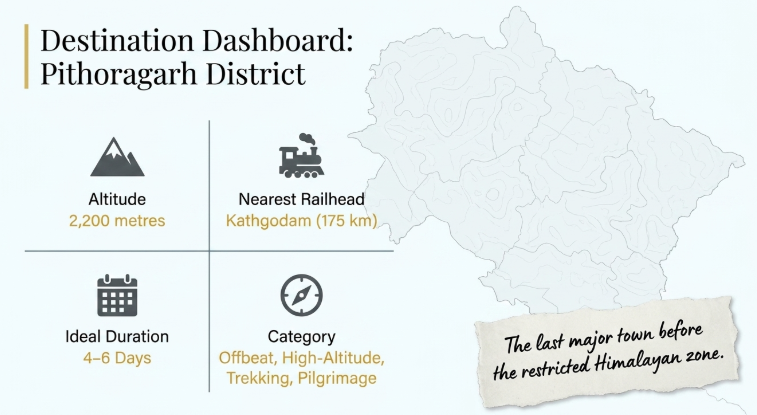
| Parameter | Details |
|---|---|
| Location | Pithoragarh District |
| Altitude | 2,200 metres |
| Best Time to Visit | April–June & September–October |
| Known For | Panchachuli views, Khaliya Top trek, Shauka heritage |
| Nearest Railhead | Kathgodam (175 km) |
| Ideal Duration | 4–6 days |
| Type of Destination | Offbeat, high-altitude, pilgrimage, trekking |
Why Munsiyari Is Uttarakhand's Most Underrated Destination
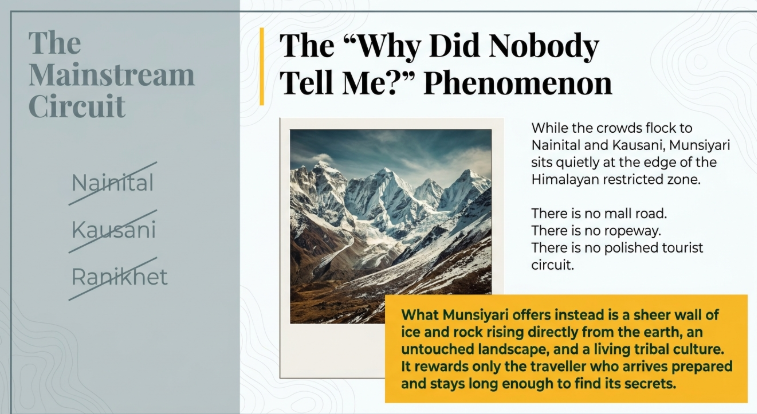
Most people who visit Uttarakhand go to Nainital. A smaller number discover Kausani or Ranikhet. Very few ever reach Munsiyari — and almost every one of those who does says the same thing within hours of arriving: why did nobody tell me about this place?
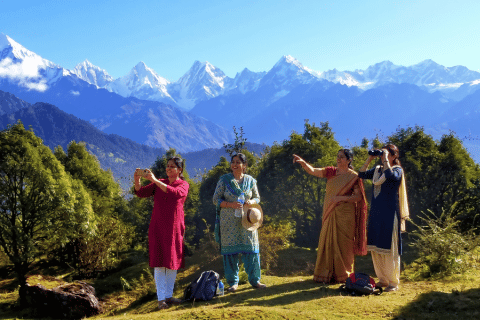
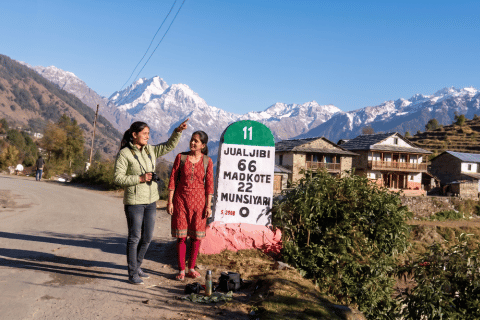
Munsiyari sits at the edge of the Himalayan restricted zone. The Johar Valley stretches north toward Tibet. The Panchachuli range — five peaks named after the five Pandavas, the highest at 6,904 metres — fills the northern horizon so completely that on a clear morning it feels less like a view and more like a wall of ice and rock rising directly from the earth.
This is not a polished tourist destination. There is no mall road, no ropeway, no organised sightseeing circuit. What Munsiyari has instead is something rarer — an untouched Himalayan landscape, a living tribal culture, and a collection of natural and spiritual experiences that reward the traveller who arrives prepared and stays long enough to find them.
The places listed in this guide are the ones that define Munsiyari. Not all of them are famous. Several are known only to people who have spent real time here. As the best DMC in Uttarakhand with 21+ years of on-ground Kumaon expertise, SnazzyTrips has been taking travellers to each of these places since 2003 — and this guide reflects that accumulated field knowledge.
"If you are also evaluating operators for your Munsiyari trip, our best travel agent in Munsiyari guide covers exactly what to look for before you book."
1. Panchachuli Viewpoint — The Defining Munsiyari Experience
Distance from town: In Munsiyari town itself Best time: 5:00am–7:00am Difficulty: Easy — flat ground, no trek required
The Panchachuli viewpoint is the first thing every Munsiyari visitor should do — and the first thing most itineraries schedule at the wrong time.
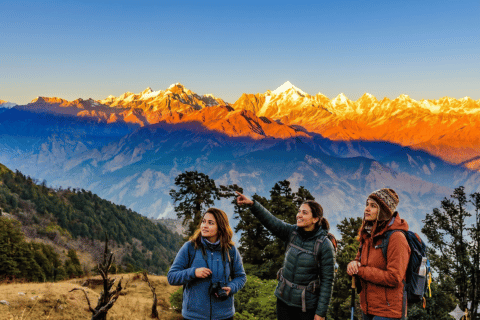
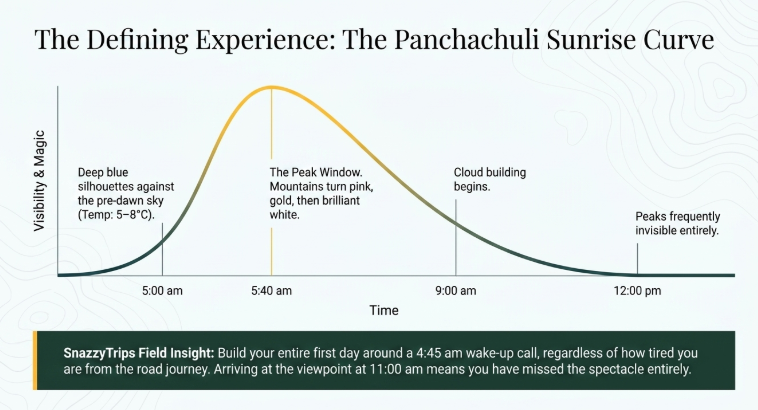
The five Panchachuli peaks are visible from the main viewpoint above Munsiyari town. At 5:00am on a clear morning, the peaks emerge from darkness as deep blue silhouettes and then — over the course of approximately 40 minutes — turn pink, then gold, then brilliant white as the sun rises behind you. This transition is one of the finest mountain experiences available anywhere in the Indian Himalayas without requiring a single step of trekking.
By 9:00am on most days, cloud has begun building around the peaks. By 10:00am the view is frequently partially obscured. By noon the mountains are often invisible entirely. A Munsiyari visitor who sees the Panchachuli viewpoint at 11:00am has seen a fraction of what it offers. The traveller who is there at 5:30am has seen everything.
What to see here:
- All five Panchachuli peaks simultaneously — the highest, Panchachuli II, at 6,904 metres
- The Johar Valley stretching northward toward Tibet
- The Gori Ganga River visible far below in the valley
- On exceptional mornings in October–November — Nanda Devi visible to the west
Practical tip: The viewpoint is 5 minutes by car from the main Munsiyari bazaar. Ask your driver for the "Panchachuli viewpoint" — locals know it immediately. Carry a warm jacket — temperatures at 5:00am are 5–8°C even in May.
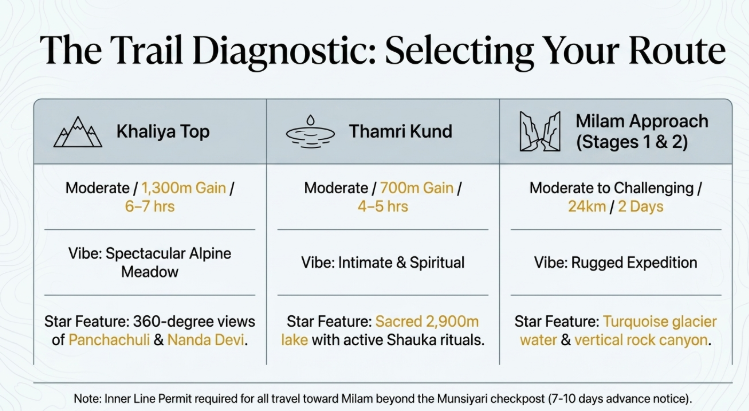
2. Khaliya Top — The Best Day Trek in Kumaon
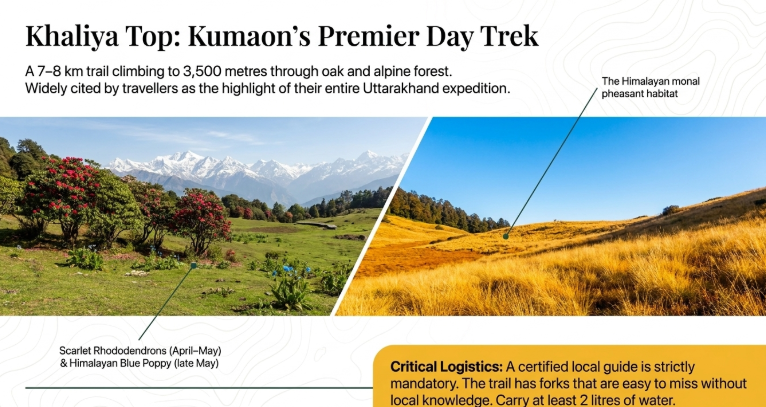
Distance from town: 7–8 km trek from Munsiyari Best time: April–May and September–October Difficulty: Easy to Moderate — 1,300 metres altitude gain Time required: Full day — 6–7 hours round trip
Khaliya Top is a high-altitude meadow at 3,500 metres — 1,300 metres above Munsiyari town — reached via a trail through oak, rhododendron, and alpine forest that is among the finest day-trek routes in the entire Kumaon Himalayas.
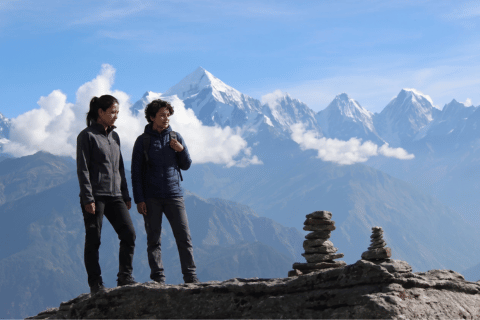
The trail begins at the Munsiyari bazaar and climbs through increasingly dramatic forest. In April and May the rhododendron trees are in full bloom — scarlet flowers against the snow-covered peaks above. In September and October the meadows turn gold and amber. At any time of year the final approach to the summit meadow opens onto a 360-degree panorama of Panchachuli, Nanda Devi, the Milam Glacier approach valley, and — on the clearest days — peaks in western Nepal.
This is the single experience that most Munsiyari travellers cite as the highlight of their entire Uttarakhand trip. It requires a full day, a local guide, and reasonable fitness — but no technical trekking experience.
What to see at Khaliya Top:
- Full Panchachuli range from a different angle than town — dramatically closer
- Nanda Devi on clear days — India's second-highest peak at 7,816 metres
- The Milam Glacier approach valley stretching north
- High-altitude meadow flora — including Himalayan blue poppy in late May
- Bird species including the Himalayan monal pheasant
Important: A local guide is mandatory for this trek. The trail has forks that are easy to miss without local knowledge. SnazzyTrips includes a certified local guide in all Munsiyari packages covering Khaliya Top.
3. Birthi Falls — The Hidden Waterfall on the Approach Road
Distance from Munsiyari: 35 km on the Thal road Best time: September–November (post-monsoon peak flow) Difficulty: Easy — short walk from roadside Time required: 1–1.5 hours
Most travellers pass Birthi Falls twice — once on the way to Munsiyari and once on the return — without stopping. This is one of the most consistently regretted Munsiyari planning mistakes.
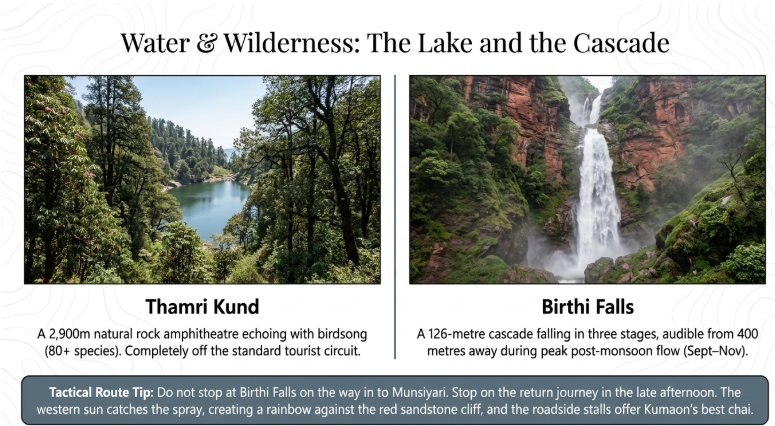
Birthi Falls is a 126-metre cascade falling in three stages down a red sandstone cliff face into a pool surrounded by mixed forest. In September and October when post-monsoon flow is at its maximum, the falls create a roar audible from the road 400 metres away. A short walk from the roadside parking brings you to a viewing point directly in front of the falls.
The cliff face behind the falls is striking — deep red and orange sandstone that makes the white water visually dramatic against it. In the late afternoon when the western sun catches the spray, a rainbow forms in the mist almost every day.
Practical tip: Stop on the way back from Munsiyari rather than the way in — afternoon light on the falls is superior to morning light. The road-side tea stalls here make some of the best roadside chai in Kumaon.
4. Thamri Kund — The Sacred Alpine Lake
Distance from town: 7 km from Munsiyari Best time: April–June and September–October Difficulty: Moderate — 700 metres altitude gain Time required: 4–5 hours round trip
Thamri Kund is a sacred alpine lake at 2,900 metres — set in a natural rock amphitheatre surrounded by pine and oak forest with Panchachuli peaks rising directly above. The Shauka community — Munsiyari's original inhabitants — have used this lake for ritual bathing for centuries. The atmosphere here is completely different from the Khaliya Top trek — quieter, more intimate, more spiritual.
The trail to Thamri Kund passes through one of the finest mid-altitude forests in the Kumaon Himalayas. Unlike Khaliya Top which is relatively open, the Thamri Kund trail stays in dense forest almost the entire way — making it particularly beautiful in monsoon when the forest is at its most lush and the stream crossings run full.
The lake itself is small — perhaps 200 metres across — but the setting is extraordinary. The surrounding rock walls and forest create a natural echo chamber for the wind and birdsong. On a clear morning, Panchachuli's reflection is visible in the lake surface.
What makes Thamri Kund unique:
- One of the few places in Kumaon where a sacred lake and a major Himalayan peak share the same sightline
- Active Shauka ritual use — local community ceremonies happen here in June
- Bird diversity on the approach trail — over 80 species recorded in the surrounding forest
- Completely off the standard tourist circuit — rarely mentioned in commercial itineraries
5. Darkot Village — Living Shauka Heritage
Distance from town: 4 km from Munsiyari Best time: Year-round Difficulty: Easy — short walk or driveable Time required: 2–3 hours
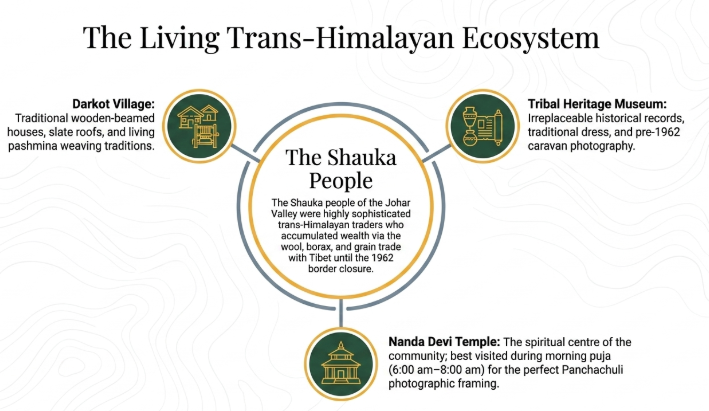
Darkot is a traditional Shauka village — one of the best-preserved examples of traditional Himalayan village architecture accessible from any Kumaon hill town. The Shauka people were historically trans-Himalayan traders who crossed the Milam and Unta Dhura passes to trade with Tibet — a practice that continued until the India-China border closure in 1962.
The village has narrow stone lanes, traditional wooden-beamed houses, and a community of women still practicing pashmina weaving on traditional looms. This is not a reconstructed cultural experience — Darkot is a living village where the craft tradition has continued without interruption because it remains economically important to the community.
What to experience here:
- Pashmina weaving demonstrations — authentic, not staged for tourists
- Traditional Shauka wooden architecture — slate roofs, carved window frames, stone foundations
- The village temple dedicated to Nanda Devi — active daily worship
- Views of Panchachuli from the village's upper terrace — arguably better framed than from the main viewpoint
- Opportunity to buy genuine Shauka craft directly from weavers
Practical note: Arrive before 11:00am when the weavers are most active. In the afternoon many village women move to the fields. A local guide who speaks the Shauka dialect makes this visit significantly more meaningful.
📍 Quick Fact: The Shauka people of the Johar Valley were among India's most sophisticated trans-Himalayan traders before the 1962 border closure. They developed a seasonal migration pattern — summers in the high Himalayan pastures near the Tibet border, winters in the lower Kumaon valleys — and accumulated significant wealth through the wool, borax, and grain trade.
6. Tribal Heritage Museum — Understanding the Johar Valley
Distance from town: In Munsiyari bazaar Best time: Year-round (closed Mondays) Difficulty: Easy — no physical demand Time required: 45 minutes to 1 hour
The Tribal Heritage Museum in Munsiyari is small — three rooms — but genuinely fascinating. It documents the history, trade routes, traditional dress, agricultural tools, and cultural practices of the Shauka community with enough depth to completely reframe what you see when you visit Darkot village or walk the Milam approach trail.
Most travellers walk past this museum because it does not look impressive from the outside. This is a mistake. The collection of historic photographs — including images of the pre-1962 Tibet trade caravans crossing the Milam Pass — and the display of traditional Shauka winter and summer clothing are genuinely irreplaceable historical records.
Entry is nominal. The museum is housed in a small government building near the main Munsiyari bazaar. Ask any local for directions — everyone knows it.
7. Nanda Devi Temple — Munsiyari's Spiritual Centre
Distance from town: In Munsiyari bazaar Best time: Early morning — 6:00am–8:00am Difficulty: Easy Time required: 30–45 minutes
The Nanda Devi temple in Munsiyari is a working temple — not a tourist attraction. It is dedicated to the presiding goddess of the Kumaon Himalayas and is the spiritual centre of the Munsiyari community. Morning puja here — attended by local residents going about their daily lives — has a completely different quality from the tourist-facing temple experiences at more visited Uttarakhand destinations.
The temple's location on a promontory above the main bazaar gives it an excellent view of the Panchachuli range — framed between the temple gateway pillars on clear mornings in a composition that photographers specifically travel to Munsiyari to capture.
8. Milam Glacier Approach — For the Adventurous
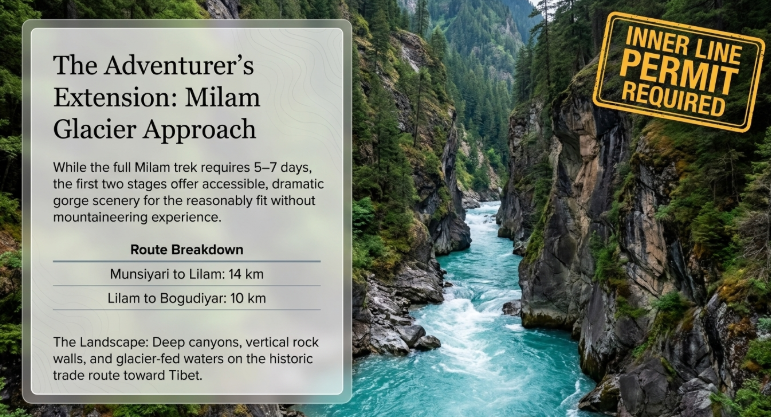
Distance from Munsiyari: 55 km to Milam village (first two stages accessible) Best time: May–June and September–October Difficulty: Moderate to Challenging Permit required: Inner Line Permit — arrange 7–10 days in advance
The full Milam Glacier trek is a 5–7 day route for serious trekkers. But the first two stages — from Munsiyari to Lilam (14 km) and Lilam to Bogudiyar (10 km) — are accessible to reasonably fit travellers without mountaineering experience, offering a genuine taste of the dramatic Gori Ganga gorge scenery on the approach.
The Gori Ganga River valley between Munsiyari and Bogudiyar is one of the most visually dramatic river gorges in the Kumaon Himalayas — deep narrow canyon, turquoise glacier-fed water, vertical rock walls, and the occasional glimpse of snow peaks above the gorge rim.
An Inner Line Permit is required for all travel beyond the Munsiyari checkpost toward Milam. SnazzyTrips arranges ILPs as standard for all Munsiyari packages that include the Milam approach.
🧭 Traveller Tip: Pack warm layers for Munsiyari even in May and June — temperatures at the Panchachuli viewpoint drop to 4–6°C at 5:00am year round. The Khaliya Top trail gains 1,300 metres from town — carry at least 2 litres of water and energy snacks for the full day trek.
🏔️ SnazzyTrips Insights — What 21 Years in Munsiyari Has Taught Us
Our teams have operated Munsiyari packages for over two decades — and the single piece of timing intelligence that transforms every Munsiyari trip is this: build your entire first day around the Panchachuli sunrise, not around checking in.
The standard mistake we see from travellers who arrive independently — and even from travellers booked through less experienced operators — is arriving at Munsiyari in the afternoon, spending the first evening in the hotel, and planning the viewpoint visit for "tomorrow morning." By tomorrow morning they are tired from the 7-8 hour road journey, they sleep through the alarm, and they arrive at the viewpoint at 8:00am when the cloud has already started building.
Our standard Munsiyari itinerary has the driver calling a wake-up at 4:45am on the first full day — regardless of how tired travellers feel from the road journey. The Panchachuli sunrise, seen properly, consistently produces what we consider the finest single moment of any Kumaon trip. Travellers who almost refused to get up that early are invariably the ones who thank us most specifically afterward.
A second field insight: Darkot village is best visited the morning after Khaliya Top — when you have already seen the Panchachuli range from altitude and can appreciate what you are looking at from the village terrace with fresh eyes. The sequence matters.
Explore our Munsiyari tour packages to plan a Munsiyari trip built around these exact timing insights.
Best Time to Visit Munsiyari in 2026
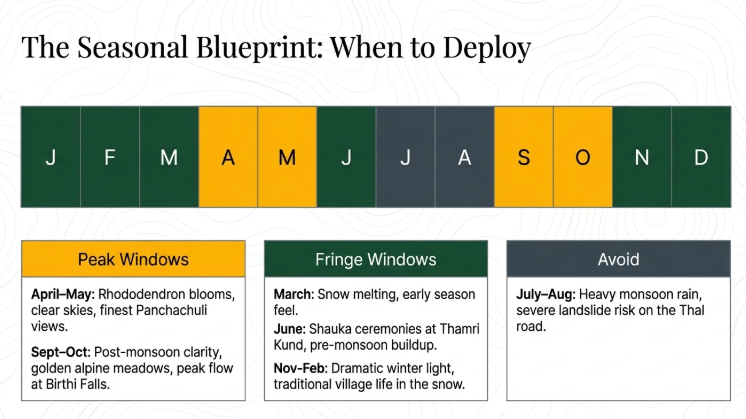
| Month | Weather | Suitability | Best For |
|---|---|---|---|
| Jan–Feb | Heavy snow possible | ⭐⭐ Low | Experienced winter travellers only |
| March | Snow melting, rhododendrons starting | ⭐⭐⭐ Good | Early season feel, cold but beautiful |
| April | Rhododendrons peak, clear views | ⭐⭐⭐⭐⭐ Excellent | Khaliya Top at its most colourful |
| May | Clear skies, best Panchachuli views | ⭐⭐⭐⭐⭐ Excellent | Best overall window |
| June | Pre-monsoon build-up | ⭐⭐⭐⭐ Very Good | Last clear month before rain |
| July–Aug | Monsoon — heavy rain | ⭐ Avoid | Thal road landslide risk |
| September | Post-monsoon clarity | ⭐⭐⭐⭐⭐ Excellent | Clearest skies of year |
| October | Golden meadows, peak clarity | ⭐⭐⭐⭐⭐ Excellent | Best photography month |
| November | Cold, early snow | ⭐⭐⭐ Good | Dramatic winter light |
Munsiyari With Family — What Works Best
Munsiyari is excellent for families who enjoy nature and culture — but requires realistic planning. The Panchachuli viewpoint, Darkot village, Tribal Heritage Museum, and Birthi Falls are all accessible for children of all ages. Thamri Kund is manageable for children above 8–10 years with reasonable fitness. Khaliya Top is suitable for children above 12 with good fitness.
For families wanting to combine Munsiyari with other Kumaon destinations, the 10-day Munsiyari, Kausani, Binsar and Nainital package from SnazzyTrips covers the full Kumaon circuit — giving families the high-altitude drama of Munsiyari combined with the gentler lake and hill station experiences at Nainital.
How to Reach Munsiyari
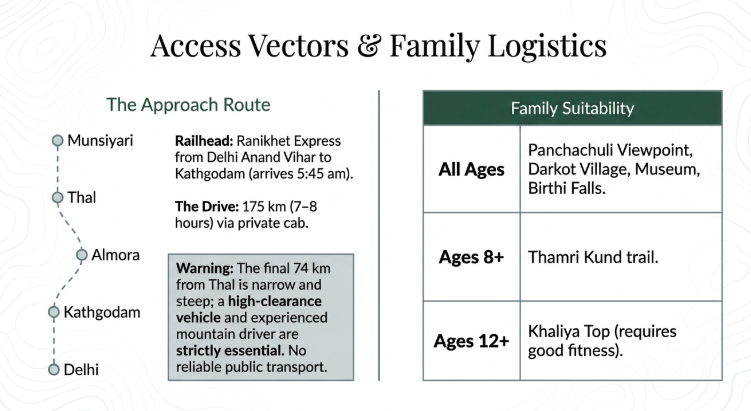
From Kathgodam: 175 km — approximately 7–8 hours by cab via Almora, Seraghat, and Thal. The Thal to Munsiyari final stretch (74 km) is the most demanding road section — narrow, steep, high-clearance vehicle essential.
Best train: Ranikhet Express from Delhi Anand Vihar — arrives Kathgodam 5:45am — giving a full day for the road journey.
Important: No public transport reliably covers the full Kathgodam to Munsiyari route in a single day. Private cab with an experienced mountain driver is the only practical option. SnazzyTrips provides Kathgodam pickup with vehicles specifically suited to the Thal road in all 4 nights 5 days Munsiyari packages and extended itineraries.
For travellers from eastern India, the Munsiyari tour package from Kolkata includes flight connections and full ground transfers as part of the package.
Munsiyari Unique Places — Seasonal Guide
| Season | Best Unique Experience |
|---|---|
| April–May | Khaliya Top with rhododendron bloom — scarlet flowers against snow peaks |
| June | Thamri Kund — Shauka community ceremonies at the sacred lake |
| September | Birthi Falls at peak monsoon flow — most dramatic waterfall experience |
| October | Khaliya Top meadows in golden autumn colour — finest photography window |
| Winter (Nov–Feb) | Darkot Village in snow — traditional Kumaon life in winter setting |
Frequently Asked Questions
Q: What are the unique places to visit in Munsiyari in 2026?
A: The most unique places in Munsiyari that most travellers never find are Thamri Kund sacred lake at 2,900 metres, Darkot village with its living pashmina weaving tradition, the Tribal Heritage Museum documenting Shauka trans-Himalayan trade history, and the first two stages of the Milam Glacier approach trail through the Gori Ganga gorge. These four experiences set Munsiyari apart from every other Kumaon hill station and are rarely included in standard itineraries.
Q: What are the best places to visit in Munsiyari with family in 2026?
A: The best family-friendly places in Munsiyari are the Panchachuli viewpoint at sunrise — accessible to all ages and requiring no trekking — Birthi Falls on the Thal road, Darkot village for cultural experiences, and the Tribal Heritage Museum. Khaliya Top trek is suitable for children above 12 with reasonable fitness. SnazzyTrips designs family-specific Munsiyari itineraries that balance accessible sightseeing with age-appropriate adventure. Check our Munsiyari tour packages for family options.
Q: What are the places to visit in Munsiyari in winter 2026?
A: Munsiyari in winter (November–February) is accessible but demanding. The Panchachuli viewpoint delivers the year's most dramatic sunrise scenes with possible snowfall adding to the drama. Darkot village in snow is one of the most atmospherically beautiful experiences in Kumaon. The Tribal Heritage Museum and Nanda Devi temple are year-round. Khaliya Top and Thamri Kund are not recommended in winter without proper mountaineering experience. January and February are best left to experienced cold-weather travellers.
Q: What is the best time to visit Munsiyari in 2026?
A: April–May and September–October are the two best windows. April gives you rhododendron bloom on the Khaliya Top trail combined with clear Panchachuli views. October delivers the finest photography conditions of the year — golden meadows, crystal clear skies, and the lowest tourist footfall outside winter. Avoid July and August when the Thal road carries significant landslide risk.
Q: How do I reach Munsiyari from Kathgodam?
A: Kathgodam to Munsiyari is 175 km — allow 7–8 hours by private cab via Almora, Seraghat, and Thal. The final 74 km from Thal to Munsiyari is the most technically demanding section and requires a high-clearance 4WD vehicle with a driver experienced on this specific road. SnazzyTrips includes this specification in all Munsiyari packages. The Ranikhet Express from Delhi arrives at Kathgodam at 5:45am — book this train for the best daily timing.
Q: Is Munsiyari good for first-time trekkers?
A: Yes — Khaliya Top is rated easy to moderate and is one of the finest introductory treks in the Indian Himalayas. The trail is well-defined, gains 1,300 metres over 7–8 km, and delivers summit views that rival treks requiring far more experience. A local guide is mandatory but no prior trekking experience is needed. Thamri Kund is an easier alternative for those who want a forest walk rather than a full-day trek.
Q: Can I combine Munsiyari with other Kumaon destinations?
A: Yes — Munsiyari works beautifully as part of a wider Kumaon circuit. The most popular combination is Munsiyari with Kausani, Binsar, and Nainital — covering high-altitude trekking, Himalayan panoramas, wildlife sanctuary, and lake town in a single 10-day trip. For independent travellers choosing a Kumaon travel agent, the best travel agent for Uttarakhand guide covers exactly what to look for before booking any Kumaon circuit.
Q: What makes Munsiyari different from other Kumaon hill stations?
A: Three things set Munsiyari apart from every other Kumaon destination. First — the Panchachuli range visible from town is arguably the finest Himalayan panorama visible from any accessible hill station in the region. Second — the living Shauka tribal culture at Darkot village and the Tribal Heritage Museum give Munsiyari a cultural depth that hill stations like Nainital and Mussoorie do not have. Third — Munsiyari is genuinely uncrowded — the long approach road keeps day-trippers away and gives the destination an unhurried pace that the more accessible Kumaon hill stations have largely lost.
Plan Your Munsiyari Visit With SnazzyTrips
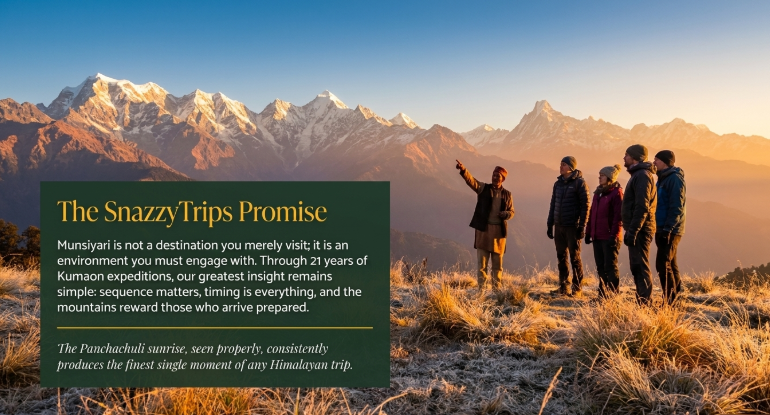
Munsiyari rewards the traveller who arrives prepared. The Panchachuli sunrise at 5:30am. The rhododendron-lined trail to Khaliya Top in April. The sacred silence of Thamri Kund. The pashmina looms of Darkot. The history in the Tribal Heritage Museum. None of these require extraordinary fitness or expensive equipment. They require only the right timing, the right guide, and an operator who has been there enough times to know exactly when and where the magic happens.
SnazzyTrips has been operating Munsiyari packages since 2003. As the best DMC in Uttarakhand for Kumaon travel — for both direct travellers and 150+ travel agent partners — we bring 21 years of Munsiyari-specific knowledge to every booking we take.
Travel Packages